

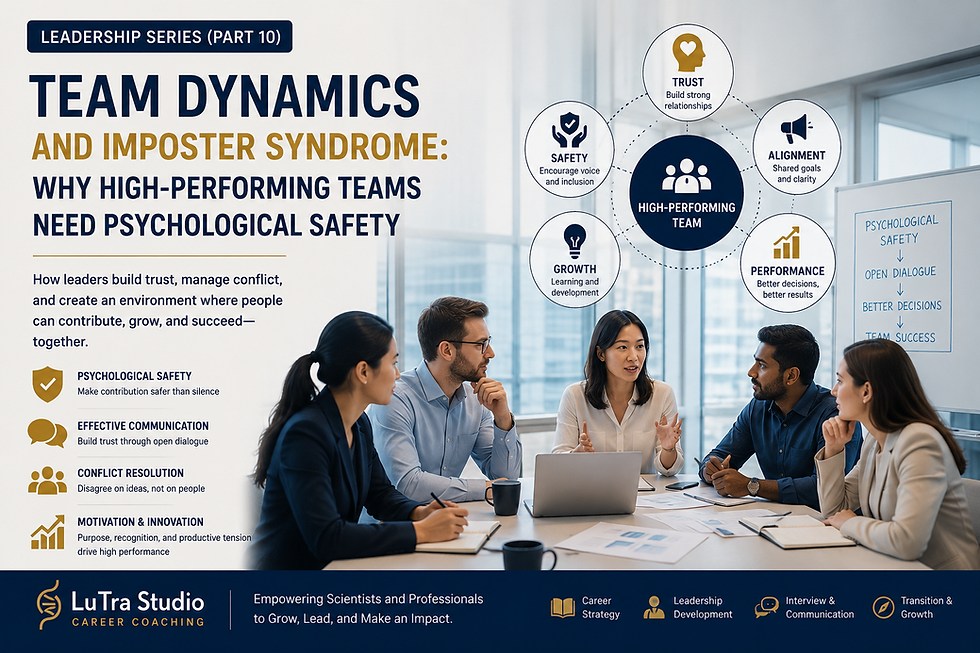
Leadership Series (Part 10)Team Dynamics and Imposter Syndrome: Why High-Performing Teams Need Psychological Safety

Executive Summary
A team can recruit talented people and still perform poorly.
Strong team dynamics depend not only on expertise, but also on communication, trust, role clarity, conflict management, motivation, and psychological safety.
Imposter syndrome can quietly weaken a team when capable people hesitate to speak, ask questions, challenge assumptions, or take ownership.
Leaders cannot eliminate every employee’s self-doubt, but they can create an environment in which uncertainty is discussed openly and mistakes become opportunities to learn.
The goal of leadership is not to remove all tension from a team. It is to create the conditions in which different people can disagree, contribute, and grow without losing trust in one another.
Introduction: A Team Can Be Talented and Still Fail
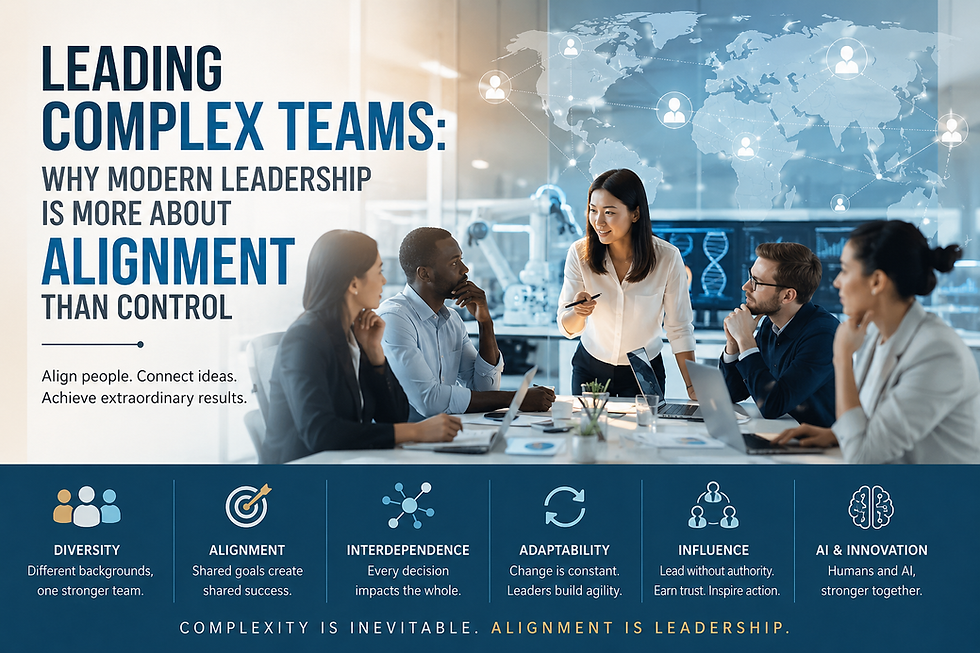
In the previous article in this Leadership Series, I discussed the complexity of modern teams and why leadership today is increasingly about alignment rather than control.
Complexity, however, is only one part of the challenge.
Even when a team has clear goals, strong technical expertise, and enough resources, its performance can still be affected by something less visible:
how team members think, interact, and feel about their place within the group.
This is where team dynamics become important.
Team dynamics describe the patterns of behavior, communication, trust, influence, and relationships that shape how people work together. These patterns affect who speaks during meetings, how disagreements are handled, whether problems are raised early, and whether team members feel responsible for the final outcome.
One psychological factor that can strongly influence these dynamics is imposter syndrome.
Imposter syndrome refers to the persistent feeling that one’s achievements are undeserved or that others may eventually discover that one is not as capable as they appear. It often affects accomplished professionals, including scientists, engineers, managers, entrepreneurs, and students.
A person experiencing imposter feelings may think:
“I was probably just lucky.”
“Everyone else understands this better than I do.”
“I should not ask that question because people may realize I do not belong here.”
These thoughts may appear personal, but their effects are organizational.
When talented people remain silent, avoid difficult assignments, overprepare for every task, or hesitate to challenge a flawed decision, the entire team loses access to their knowledge.
That is why leaders should not treat imposter syndrome only as an individual confidence problem.
It can also become a team performance problem.
Team Dynamics Are Created, Not Discovered
Many leaders assume that a group of talented people will naturally become a good team.
That rarely happens automatically.
A team develops its own unwritten rules over time:
Who is allowed to disagree?
Whose opinions receive the most attention?
Is asking for help viewed as responsible or weak?
Are mistakes discussed or hidden?
Does the team reward collaboration or individual visibility?
Can junior employees challenge senior leaders?
These unwritten rules eventually become the team culture.
A leader therefore does more than assign work. The leader shapes the environment in which people decide whether it is safe to contribute.
This is especially important in scientific and technical organizations, where expertise is often unevenly distributed.
A process-development scientist may understand manufacturing risks that a discovery scientist has never encountered. A junior analytical scientist may notice a data-quality issue before a senior project leader does. A regulatory colleague may identify a future approval risk that appears unimportant during early research.
The value of the team depends on whether these people feel able to speak.
Team Composition: The Best People Are Not Always the Best Team
One of the most important factors in team dynamics is team composition.
Traditional teams are often formed based on availability, organizational structure, or existing reporting lines. Members are expected to collaborate, divide responsibilities, and prioritize the collective task.
Other teams are assembled specifically around exceptional skills. These are sometimes described as virtuoso teams—groups made up of highly talented individuals selected for their unique expertise rather than their ability to fit comfortably into an existing structure.
Both models can work, but they create different leadership challenges.
A traditional team may have stability and predictable collaboration, but it may also become too comfortable and avoid difficult questions.
A virtuoso team may produce breakthrough ideas, but strong personalities, professional pride, and competition can make coordination more difficult.
Consider a biotech program developing a new drug-delivery platform.
The team may include:
A formulation scientist focused on performance
A process engineer focused on scalability
An analytical scientist focused on measurement and product quality
A clinician focused on patient benefit
A regulatory expert focused on evidence and risk
A business leader focused on market value and funding
Selecting the most accomplished person in each area does not guarantee success.
The team also needs people who can:
Explain their reasoning
Listen across disciplines
Accept that another function may see risks they do not
Separate disagreement from personal criticism
Adjust their position when new evidence appears
Leaders should therefore ask two questions when building a team:
“What expertise do we need?”
and
“What behaviors will allow that expertise to work together?”
Imposter Syndrome Can Change How People Participate
Imposter feelings do not always look like insecurity.
Sometimes they appear as perfectionism.
Sometimes they appear as overwork.
Sometimes they appear as defensiveness or an unwillingness to delegate.
A scientist experiencing imposter syndrome may repeat an experiment many more times than necessary because they fear presenting imperfect data.
A new manager may avoid making decisions because they worry that experienced employees will question their authority.
A junior employee may stay silent during a meeting even after identifying a serious issue.
A senior leader may refuse to admit uncertainty because they believe leadership requires having every answer.
These behaviors affect team dynamics in different ways.
The perfectionist may slow down decisions.
The silent expert may allow preventable mistakes to continue.
The defensive leader may discourage feedback.
The overworked employee may eventually burn out.
The problem is not simply that these individuals lack confidence. The problem is that the team may not have created a healthy way to discuss uncertainty.
Psychological Safety Does Not Mean Lowering Standards
A strong response to imposter syndrome is not constant reassurance or telling everyone that every idea is equally good.
That can create a different problem.
High-performing teams still need:
High standards
Accountability
Honest feedback
Technical rigor
Difficult decisions
Psychological safety means that people can participate in these processes without fearing humiliation or retaliation.
A psychologically safe team can say:
“I do not understand this assumption.”
“I made a mistake in the analysis.”
“I disagree with the current strategy.”
“I need help.”
“The data do not support our conclusion yet.”
These statements do not weaken a team.
They protect it.
In scientific development, the cost of remaining silent can be enormous. A hidden manufacturing concern can delay a program. An unreported analytical inconsistency can undermine data quality. A junior employee who is afraid to challenge an assumption may allow the wrong experiment to continue for months.
Good leaders therefore create safety for candor, not safety from accountability.
Effective Communication: Make the Invisible Visible
Communication is one of the most important components of healthy team dynamics.
However, effective communication is not simply the frequency of meetings or the number of emails sent.
It involves making expectations, assumptions, risks, and decisions visible.
For example, after a cross-functional meeting, different functions may leave with different interpretations:
Research believes the formulation is ready.
Manufacturing believes additional development is still required.
Regulatory believes the decision remains open.
Management believes the team has reached agreement.
The meeting happened, but alignment did not.
A leader can reduce this problem by ending important discussions with four questions:
What decision did we make?
What remains unresolved?
Who owns the next action?
When will we review the outcome?
This simple practice reduces ambiguity and helps team members feel more confident about their roles.
Leaders should also pay attention to who is not speaking.
If the same three people dominate every meeting, the leader may need to ask others directly:
“We have heard the research perspective. What are we missing from manufacturing?”
“You have been closest to the data. What concerns do you see?”
“Does anyone interpret the result differently?”
The goal is not to force participation. It is to demonstrate that different perspectives are expected and valued.
Conflict Is Not Always a Sign of a Dysfunctional Team
Many teams try to avoid conflict because they associate disagreement with poor collaboration.
In reality, the absence of conflict can be more dangerous than conflict itself.
A team that never disagrees may be:
Avoiding difficult topics
Deferring excessively to authority
Protecting relationships at the expense of performance
Experiencing groupthink
Healthy conflict focuses on ideas, evidence, priorities, and trade-offs.
Unhealthy conflict becomes personal, political, or punitive.
For example, these two statements create very different dynamics:
“Your plan is unrealistic.”
and
“The current timeline assumes that scale-up will succeed without another engineering run. Can we examine that assumption?”
The second statement still challenges the plan, but it directs attention toward the work rather than the person.
Leaders can improve conflict resolution by establishing several norms:
Critique ideas, not individuals.
Use evidence whenever possible.
Clarify the decision-making process.
Allow dissent before the final decision.
Once a decision is made, align around execution unless new evidence emerges.
A strong team does not eliminate disagreement. It learns how to disagree without destroying trust.
Motivation Is Personal, but Purpose Is Shared
Another essential component of team dynamics is motivation.
Leaders sometimes assume that everyone is motivated by the same things:
Compensation
Promotion
Recognition
Interesting work
In reality, different people may value different outcomes.
One employee may want technical mastery.
Another may want greater autonomy.
Another may care deeply about patient impact.
Another may want opportunities to lead.
Another may value stability and predictability.
A leader cannot create a unique organization for every employee, but the leader can understand what matters to each person and connect individual motivation to the team’s shared purpose.
For example, a junior scientist who wants professional growth may be motivated by presenting results to senior leadership.
An experienced scientist may value ownership of a difficult technical problem.
A cross-functional project manager may be motivated by the opportunity to shape strategy.
Recognition should also be specific.
Instead of saying:
“Great job.”
a leader can say:
“Your early identification of the stability issue allowed the team to redesign the study before we committed additional resources.”
Specific recognition helps people understand how their contribution matters.
This is especially important for people experiencing imposter feelings because it connects achievement to observable behavior rather than vague praise.
Innovation Requires Productive Tension
Innovation is another important result of healthy team dynamics.
Innovative teams need both freedom and discipline.
Too much control can suppress experimentation.
Too little structure can produce disconnected ideas without execution.
Leaders must create productive tension between:
Creativity and feasibility
Scientific ambition and development risk
Speed and quality
Individual expertise and collective decisions
Consider an early-stage therapeutic program.
The discovery team may want to explore several innovative formulations. The development team may want to narrow the program quickly to reduce cost and complexity.
Both perspectives are necessary.
Without exploration, the team may settle for an average solution.
Without convergence, the team may never produce a developable product.
The leader’s role is not to choose creativity or execution.
It is to define when the team should explore and when it must commit.
Useful practices may include:
Separate brainstorming from evaluation.
Invite ideas before discussing constraints.
Define clear criteria for selecting concepts.
Run small experiments to test uncertainty.
Document why ideas were accepted or rejected.
Innovation becomes more sustainable when team members understand how ideas move into decisions.
How Leaders Can Reduce the Impact of Imposter Syndrome
Leaders cannot diagnose or eliminate imposter syndrome, but they can reduce the organizational conditions that amplify it.
Normalize Learning Without Normalizing Poor Preparation
Leaders can acknowledge that new roles involve uncertainty while still expecting people to prepare and improve.
A new manager should not be expected to know everything on the first day. They should be expected to ask questions, seek feedback, and learn.
Make Expectations Explicit
Ambiguous expectations often increase self-doubt.
Clarify:
What success looks like
Which decisions the employee owns
When escalation is appropriate
How performance will be evaluated
Give Evidence-Based Feedback
Avoid only saying, “You are doing fine.”
Explain what the person did well, what impact it created, and what they should improve next.
Share Developmental Stories
Leaders who discuss their own learning process can reduce the illusion that successful people have always been confident or fully prepared.
This does not require oversharing. A simple statement can be enough:
“When I first led a cross-functional program, I also struggled with influencing people who did not report to me.”
Create Multiple Ways to Contribute
Not everyone performs best in fast-moving meetings.
Allow team members to contribute through written comments, one-on-one conversations, pre-reads, or structured roundtable discussions.
Reward Early Risk Identification
When someone raises a concern, do not automatically treat them as negative or resistant.
Thank them for making the risk visible, then examine the evidence.
Team Dynamics in Remote and Hybrid Work
Remote and hybrid teams introduce additional challenges.
In an office, people often receive informal signals about how their work is progressing. They can ask a quick question, observe reactions, or clarify misunderstandings immediately.
Remote workers may have fewer opportunities for this informal feedback.
This can intensify imposter feelings, particularly for new employees who may wonder:
Am I contributing enough?
Does my manager trust me?
Am I missing important conversations?
Do I belong on this team?
Leaders of hybrid teams should be deliberate about:
Sharing context, not only tasks
Documenting decisions
Creating predictable one-on-one meetings
Avoiding important conversations that include only people physically present
Recognizing contributions across locations
Making onboarding more structured
Remote inclusion does not happen automatically. It requires intentional team design.
From Individual Confidence to Organizational Performance
It is tempting to view imposter syndrome as an issue that individuals must solve privately.
But leaders should consider the broader environment.
If many people on a team are afraid to ask questions, the problem may not be individual confidence.
It may be the team culture.
If junior employees rarely challenge senior employees, the issue may not be experience.
It may be power dynamics.
If high performers constantly overwork because they fear appearing inadequate, the organization may be rewarding unhealthy behavior.
Leadership requires us to ask not only:
“How can this person become more confident?”
but also:
“What signals is the organization sending about competence, mistakes, and belonging?”
Team Leadership as a Career Skill
In LuTra Studio Career Coaching, I often work with scientists and technical professionals who want to move into management or leadership roles.
Many have already demonstrated strong technical ability.
Their next challenge is learning how to:
Build trust
Give useful feedback
Manage conflict
Motivate different personalities
Create psychological safety
Lead people who may know more than they do in specific areas
This transition can itself create imposter feelings.
A newly promoted manager may think:
“I was successful as a scientist, but I do not know whether I can lead people.”
That feeling is understandable because leadership is a different discipline.
The solution is not pretending to have every answer.
It is deliberately developing new capabilities.
At LuTra Studio, career coaching goes beyond resume and interview preparation. It also helps scientists, engineers, and professionals think strategically about the leader they want to become and the skills required for their next stage of growth.
My book, Hacking the Hunt: The Strategic Playbook for Landing Your Dream Job, also explores a related idea: career success is not only about winning an opportunity. It is about building the self-awareness, communication skills, and strategic judgment needed to grow after receiving that opportunity.
How LuTra Studio Career Coaching Supports Leadership Growth
At LuTra Studio, career coaching is not limited to resume editing or interview preparation.
Many of the scientists, engineers, and biotech professionals I work with are already technically strong. Their real challenge is preparing for the next stage of their careers—where success depends less on individual execution and more on communication, influence, judgment, and leadership.
Through LuTra Studio Career Coaching, I help professionals think more strategically about questions such as:
How can I transition from an individual contributor into a team leader?
How should I prepare for my first management role?
How can I build confidence without pretending to know every answer?
How do I communicate my value more clearly in interviews and at work?
How can I lead cross-functional teams when not everyone reports to me?
What leadership skills do I need for my next career stage?
These conversations often go beyond finding the next job.
They focus on building a long-term career strategy that aligns technical strengths, personal values, leadership potential, and professional goals.
For professionals experiencing imposter feelings, career coaching can also provide a structured space to separate actual skill gaps from self-doubt. The goal is not to offer empty reassurance, but to identify concrete evidence of capability, recognize areas that still require growth, and develop a practical plan for moving forward.
Whether someone is transitioning from academia to industry, preparing for a promotion, entering management, or repositioning for a more senior role, the objective is the same:
To help professionals understand their value, communicate it clearly, and grow into leaders who can help others succeed.
At LuTra Studio, I believe career development is not only about landing the next opportunity.
It is about becoming ready for the responsibilities, complexity, and leadership challenges that come with it.
Conclusion: High-Performing Teams Make Contribution Safer Than Silence
Healthy team dynamics do not mean that everyone always agrees.
They do not mean that conflict disappears or that performance standards become lower.
They mean that people understand the goal, trust the process, and feel responsible for contributing what they know.
Imposter syndrome becomes especially damaging when capable people believe that silence is safer than participation.
Leaders can change that calculation.
They can create teams where:
Questions are treated as part of learning
Risks are raised before they become crises
Feedback is direct but respectful
Contributions are recognized specifically
Disagreement improves decisions
Expertise is shared rather than protected
A leader does not need to make every team member feel confident all the time.
But a leader should create an environment where uncertainty does not prevent contribution.
Because the strongest teams are not made up of people who never doubt themselves.
They are made up of people who can acknowledge uncertainty, trust one another, and continue moving forward together.

Comments