

Leadership Series (Part 9)Leading Complex Teams: Why Modern Leadership Is More About Alignment Than Control

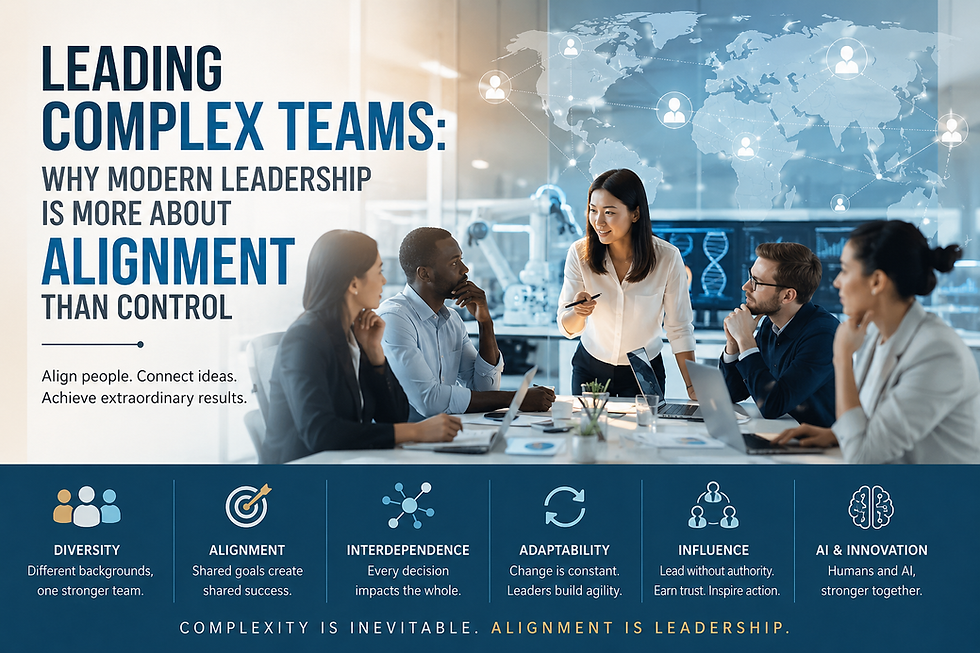
Executive Summary - leading complex teams
Modern leadership is no longer about managing people—it is about managing complexity.
Team complexity is driven by interdependence, not simply by team size.
Successful leaders create alignment across different functions, cultures, and perspectives.
Matrix organizations and AI-powered workflows are reshaping how teams collaborate.
Technical expertise alone is no longer enough; leadership requires influence, communication, and systems thinking.
Leading complex teams has become one of the most valuable career skills in today’s global workplace.
Introduction: Leadership Has Become More Complex Than Ever
Throughout this Leadership Series, we have explored different dimensions of leadership, including:
Everyday Leadership
Self-Awareness
Personality and Leadership
Golden Circle Leadership
Communication Leadership
Cross-Cultural Communication
Leadership Styles and Influence
Inclusive Leadership
Each of these topics focuses on an important capability that helps us become better leaders.
However, as organizations continue to evolve, leadership itself has become significantly more complex.
Years ago, a manager might have led a team of people sitting in the same office, speaking the same language, sharing similar educational backgrounds, and working toward a single objective.
Today’s workplace looks very different.
A single biotech program may involve:
Research scientists in Boston
Manufacturing engineers in Singapore
Regulatory specialists in Europe
Clinical teams across multiple countries
Commercial organizations in California
External CROs and CDMOs
AI-powered analytical platforms supporting decision-making
These individuals often report to different managers, work across multiple time zones, represent different organizational priorities, and communicate through different cultural perspectives.
The challenge is no longer simply managing people.
It is managing complexity.
One of the biggest lessons I have learned throughout my career—from academic research to biotechnology startups and cross-functional product development—is this:
Modern leadership is less about giving directions and more about creating alignment.
The best leaders are not the ones who make every decision themselves.
They are the ones who create an environment where different experts can move toward a common goal.
Complexity Is Not About Team Size
One of the biggest misconceptions about leadership is that complex teams are simply large teams.
In reality, complexity has surprisingly little to do with headcount.
A team of six people can be significantly more complex than a department of fifty.
What truly creates complexity is something else: Interdependence.
The more people rely on one another to complete their work, the more complex the system becomes.
Think about a modern mRNA therapeutic development program.
A promising lipid nanoparticle formulation may be successfully developed by the research team.
However:
Manufacturing may determine that the formulation cannot be produced consistently at commercial scale.
Analytical Development may discover stability or characterization issues.
Quality Assurance may require additional documentation before moving forward.
Regulatory Affairs may request comparability studies following process changes.
Clinical Development may need to adjust timelines because manufacturing is delayed.
Commercial teams may have to revise launch expectations.
Every decision made by one function influences every other function.
Nobody is truly working independently anymore.
This is why today’s leaders spend far less time making technical decisions themselves and far more time helping different teams work together.
Leadership has gradually shifted from directing individuals to coordinating complex systems.
And as organizations become increasingly global and multidisciplinary, this complexity will only continue to grow.
Five Sources of Team Complexity
Complex teams rarely become challenging because people lack talent.
More often, complexity arises because talented people are trying to solve different problems at the same time.
Over the years, I’ve realized that most project delays are not caused by technical failures.
They are caused by coordination failures.
When leaders understand the sources of complexity, they can proactively build systems that improve communication, alignment, and collaboration before problems begin to affect the entire organization.
Below are five of the most common sources of complexity that exist in modern organizations.
1. Diversity Goes Beyond Culture
When people hear the word “diversity,” they often think about nationality, ethnicity, or language.
While cultural diversity certainly matters, modern teams are diverse in many other ways.
For example, team members may differ in:
Educational background
Scientific discipline
Professional experience
Communication style
Personality
Problem-solving approach
Generational perspective
These differences often create tremendous opportunities for innovation.
At the same time, they can also create misunderstanding if leaders assume that everyone approaches problems in the same way.
One example I frequently see in biotech is the difference between scientists and engineers.
Scientists naturally ask:
“Can we make this work?”
Engineers often ask:
“Can we make this work consistently?”
Manufacturing teams ask:
“Can we manufacture this reproducibly at commercial scale?”
Quality teams ask:
“Can we document every step and meet regulatory expectations?”
Commercial teams ask:
“Will physicians and patients actually adopt this product?”
Each team is solving a different piece of the puzzle.
None of them are wrong.
They simply define success differently.
One of the leader’s responsibilities is helping every function understand why these different perspectives all matter.
True diversity is not about making everyone think the same way.
It is about creating an environment where different perspectives improve better decisions.
2. Goal Misalignment
One of the biggest challenges in complex teams is that everyone may be working hard—but not necessarily toward the same objective.
This is especially common in cross-functional organizations.
Each department naturally optimizes for its own priorities.
Research may prioritize scientific innovation.
Manufacturing focuses on scalability and robustness.
Quality emphasizes compliance.
Regulatory concentrates on patient safety and approval strategy.
Commercial teams focus on timelines and market needs.
Finance looks at budgets and resource allocation.
From the perspective of each department, these priorities make perfect sense.
The problem arises when these priorities begin competing with one another.
A project can easily stall when every function optimizes locally without considering the broader organizational objective.
This is why I believe one of the most important responsibilities of a leader is not simply assigning tasks.
It is creating alignment.
Alignment means helping every member understand how their individual success contributes to the team’s overall mission.
Once people understand the bigger picture, collaboration becomes much easier.
3. High Interdependence
Modern organizations are becoming increasingly interconnected.
Very few projects can succeed through the efforts of a single department.
This is particularly true in biotechnology.
Developing a new therapy requires collaboration among multiple groups, including:
Discovery Research
Process Development
Analytical Development
Manufacturing
Quality Assurance
Regulatory Affairs
Clinical Development
Commercial Strategy
Each function depends on information generated by another team.
A delay in one area quickly propagates throughout the entire program.
This is one of the biggest differences between working independently and working within complex organizations.
Individual excellence is no longer enough.
Organizational success depends on collective execution.
Throughout my career, I have learned that many successful product launches were not necessarily driven by the smartest scientists.
They were driven by teams that communicated effectively, trusted one another, and aligned around a common objective.
That is why modern leadership is increasingly about enabling collaboration rather than directing individual contributors.
4. Continuous Change
One characteristic shared by almost every modern organization is that change has become constant.
Scientific discoveries evolve.
Regulatory expectations change.
Competitors introduce new technologies.
Funding priorities shift.
Artificial intelligence is rapidly transforming the way we work.
Unlike the past, projects rarely follow a perfectly linear path from beginning to end.
Instead, teams must continuously adapt to new information.
Many new leaders believe their primary responsibility is to predict every possible challenge before it happens.
Over time, however, I have learned that prediction is becoming less valuable than adaptability.
The most successful leaders are not those who eliminate uncertainty.
They are the ones who help their teams navigate uncertainty with confidence.
This requires creating an environment where people feel comfortable sharing concerns early, adjusting plans quickly, and learning from unexpected outcomes rather than assigning blame.
One lesson I have repeatedly observed throughout my career is that flexibility should never be mistaken for a lack of direction.
Strong leaders maintain a clear vision while remaining flexible in execution.
The destination remains the same.
The path may change.
5. Scale Increases Complexity Exponentially
As organizations grow, communication becomes dramatically more complicated.
Many people assume communication grows proportionally with team size.
In reality, communication complexity grows exponentially.
Every additional stakeholder introduces:
New relationships
New communication pathways
New priorities
New opportunities for misunderstanding
A five-person team may communicate naturally.
A fifty-person organization requires deliberate communication systems.
A global organization with hundreds of employees requires entirely different operating models.
This is one reason many innovative companies intentionally keep project teams relatively small.
Amazon famously introduced the concept of the “Two-Pizza Team,” suggesting that a team should be small enough to be fed with two pizzas.
The principle is simple.
Smaller teams communicate faster, make decisions more efficiently, and adapt more quickly.
As organizations scale, leaders must increasingly rely on systems rather than individual oversight.
Successful leadership becomes less about supervising every detail and more about designing an environment where information flows efficiently.
Matrix Organizations: Leadership Without Authority
Another major source of complexity in today’s workplace is the widespread adoption of matrix organizations.
Unlike traditional organizational structures, matrix organizations rarely follow a simple reporting hierarchy.
Instead, employees often report to one manager while simultaneously working on projects led by someone else.
In many biotechnology companies, a project leader may coordinate efforts across:
Discovery Research
Process Development
Quality
Regulatory Affairs
Clinical Development
Commercial Strategy
Yet none of these individuals may report directly to that project leader.
This fundamentally changes what leadership looks like.
Success is no longer determined by formal authority.
It depends on something much more difficult to build:
Trust
Credibility
Communication
Influence
Earlier in this Leadership Series, we discussed the difference between authority and influence.
Matrix organizations make that distinction even more obvious.
People rarely collaborate simply because someone has a higher title.
They collaborate because they believe in the shared mission and trust the person leading it.
One of the biggest transitions I experienced moving from academia into the biotechnology industry was realizing that influence often matters far more than organizational hierarchy.
The ability to align people who do not report to you has become one of the defining leadership skills of modern organizations.
Great leaders in matrix environments spend less time giving instructions and more time building relationships, creating transparency, and helping different teams understand how their work contributes to a common objective.
In many ways, matrix organizations remind us that leadership is no longer about managing direct reports.
It is about connecting people across an increasingly complex network.
A Lesson I Learned in Biotech
One of the biggest lessons I have learned throughout my career in biotechnology is that complex teams rarely fail because people lack competence.
More often, they struggle because different teams are optimizing for different objectives.
I remember working on several cross-functional development programs where each function genuinely believed they were making the best decision.
The research team believed the formulation was ready.
Manufacturing raised concerns because the process was difficult to scale consistently.
Analytical Development identified additional characterization work that needed to be completed.
Quality Assurance required more documentation before the next milestone.
Regulatory Affairs questioned whether certain process changes would require additional comparability studies.
Initially, every team believed another function was creating unnecessary delays.
As discussions continued, however, something became clear.
Nobody was wrong.
Each team was simply solving a different problem.
Researchers were trying to maximize scientific performance.
Manufacturing focused on robustness and reproducibility.
Quality protected compliance.
Regulatory focused on long-term approval strategy.
Commercial considered launch timelines and market expectations.
Each perspective was both reasonable and necessary.
The challenge was never technical expertise.
The challenge was helping everyone understand how their individual priorities fit into a much larger system.
That experience fundamentally changed the way I think about leadership.
Today, when projects become difficult, I rarely ask,
“Who is causing the problem?”
Instead, I ask,
“Where is the alignment breaking down?”
That question almost always leads to a much more productive conversation.
AI Is Changing Team Complexity Again
Just as organizations have learned to manage increasingly global and cross-functional teams, another transformation is already underway.
Artificial intelligence is fundamentally changing how teams operate.
In the past, project teams consisted almost entirely of people.
Today, many organizations are beginning to work alongside:
AI copilots
Large language models
Laboratory automation
Robotics
Digital twins
Predictive analytics platforms
External technology partners
In other words, modern leaders are no longer coordinating only people.
They are coordinating an entire ecosystem.
In biotechnology, this shift is becoming increasingly visible.
AI is helping scientists design experiments.
Automation platforms are performing routine laboratory workflows.
Machine learning models assist with data analysis.
Digital systems continuously monitor manufacturing processes.
The leader’s role is evolving.
Rather than making every technical decision personally, leaders increasingly need to determine:
Which decisions should remain human?
Which processes should be automated?
How can AI augment—not replace—the expertise of scientists and engineers?
I believe this is one of the defining leadership challenges of the next decade.
Successful organizations will not simply adopt AI.
They will learn how to build teams where humans and intelligent systems work together effectively.
Leadership, therefore, becomes less about supervising individuals and more about orchestrating an increasingly complex network of people, technology, and knowledge.
Complexity Cannot Be Solved by Working Harder
One of the most common mistakes I see among new managers is believing that every complex problem can be solved simply by working harder.
When projects begin falling behind, the instinctive response is often:
Schedule more meetings.
Send more emails.
Create more reports.
Track more metrics.
Increase oversight.
Unfortunately, complexity rarely responds to additional effort alone.
In many cases, these actions actually make the system more complicated.
More meetings create less time for execution.
More emails generate more confusion.
More approvals slow down decision-making.
What complex organizations usually need is not more activity.
They need more clarity.
Throughout my career, I have found that high-performing teams almost always share several characteristics:
Clear priorities
Shared goals
Open communication
Psychological safety
Mutual trust
These qualities reduce unnecessary complexity before it grows into organizational friction.
One of my favorite leadership principles is this:
Don’t add more processes. Remove unnecessary complexity.
The best leaders are often not the ones who build the most sophisticated systems.
They are the ones who simplify complexity so that everyone can focus on what truly matters.
As organizations continue to evolve, the ability to simplify without oversimplifying may become one of the most valuable leadership skills of all.
From Technical Expert to Team Leader: A Different Career Transition
One of the most common conversations I have through LuTra Studio Career Coaching is with scientists and engineers preparing for the next stage of their careers.
Many of them ask questions like:
“How do I become a manager?”
“What skills do I need beyond technical expertise?”
“How can I prepare for leadership roles?”
Interestingly, very few of them lack technical ability.
Instead, the biggest challenge is learning how to transition from being an individual contributor to becoming someone who enables others to succeed.
Early in our careers, we are rewarded for our own accomplishments.
We publish papers.
Design experiments.
Solve technical problems.
Develop innovative technologies.
These achievements are important.
However, leadership changes the definition of success.
As your career progresses, success becomes less about what you can accomplish and more about what your team can accomplish together.
This transition is particularly challenging for scientists and engineers because most graduate programs and technical training emphasize scientific expertise rather than leadership development.
Yet many of the skills that determine long-term career success have little to do with technical knowledge alone.
They include:
Leading cross-functional teams
Navigating organizational complexity
Building influence without authority
Communicating across disciplines
Making decisions under uncertainty
Creating alignment among people with different priorities
These are leadership skills that rarely appear in textbooks but become increasingly important throughout a career.
How LuTra Studio Career Coaching Can Help
At LuTra Studio, my career coaching extends far beyond resume reviews or interview preparation.
I work with scientists, engineers, biotech professionals, and emerging leaders who want to think more strategically about their long-term careers.
Whether someone is:
Transitioning from academia to industry
Preparing for their first management position
Pursuing senior leadership opportunities
Building executive presence
Learning to lead global and cross-functional teams
our conversations often focus on a much bigger question:
What kind of leader do you want to become?
Because career development is not simply about landing the next job.
It is about building the capabilities that allow you to create meaningful impact throughout your career.
Leadership is one of those capabilities.
And like any technical skill, it can be learned, practiced, and continuously improved.
Beyond This Leadership Series
Many of the ideas shared throughout this Leadership Series—including the concepts discussed in this article—reflect lessons I have learned throughout my own journey across academia, biotechnology, startups, and global organizations.
These experiences eventually inspired me to write my book,
Although the book focuses on career strategy and navigating today’s competitive job market, one of its central messages is that long-term career success extends far beyond finding your next opportunity.
Sustainable careers are built by continuously developing the ability to:
Communicate effectively
Build trust
Influence others
Adapt to uncertainty
Lead increasingly complex teams
In many ways, finding the right job is only the beginning.
Learning how to grow into the leader your organization needs is the journey that follows.
Conclusion: Great Leaders Don’t Reduce Complexity—They Create Alignment
Modern leadership is fundamentally different from what it was even a decade ago.
Today’s leaders are no longer responsible only for directing people.
They are expected to navigate:
Cross-functional organizations
Matrix structures
Global collaboration
Rapid technological change
Artificial intelligence
Constant uncertainty
The complexity of organizations will continue to increase.
But complexity itself is not the problem.
The real challenge is helping different people move toward the same objective.
That is why I believe the role of a leader is no longer to have all the answers.
Instead, it is to create an environment where the right people can solve the right problems together.
Leadership has never been about controlling every decision.
It has always been about creating clarity, building trust, and aligning people around a shared purpose.
As organizations become increasingly interconnected, perhaps the greatest competitive advantage a leader can develop is not technical expertise alone.
It is the ability to connect people, ideas, and systems in ways that allow everyone to succeed together.
Because in today’s world, leadership is no longer about control.
It is about creating alignment in the face of complexity.



Comments