

From In Vivo CAR-T to CAR-NK: When Delivery Becomes Immune Regulation


The first wave of in vivo CAR research asked a manufacturing question: can we generate CAR-T cells directly inside a patient instead of collecting, engineering, expanding, and reinfusing them?
That question remains important. But a new study in Nature Biotechnology pushes the field toward a more interesting one:
If CAR engineering moves inside the body, can the delivery system also choose the immune-cell chassis and tune its functional state?
Chen and colleagues designed ligand-directed lipid nanoparticles that deliver CAR mRNA selectively to natural killer cells. Their best NKG2D-targeted construct produced high NK-cell transfection, while an NKG2A-targeted version sometimes performed better despite generating fewer CAR-positive cells. The reason may be biological: NKG2A is not merely an address for delivery. It is also an inhibitory NK-cell receptor, so engaging it may alter the checkpoint environment in which the newly expressed CAR operates.
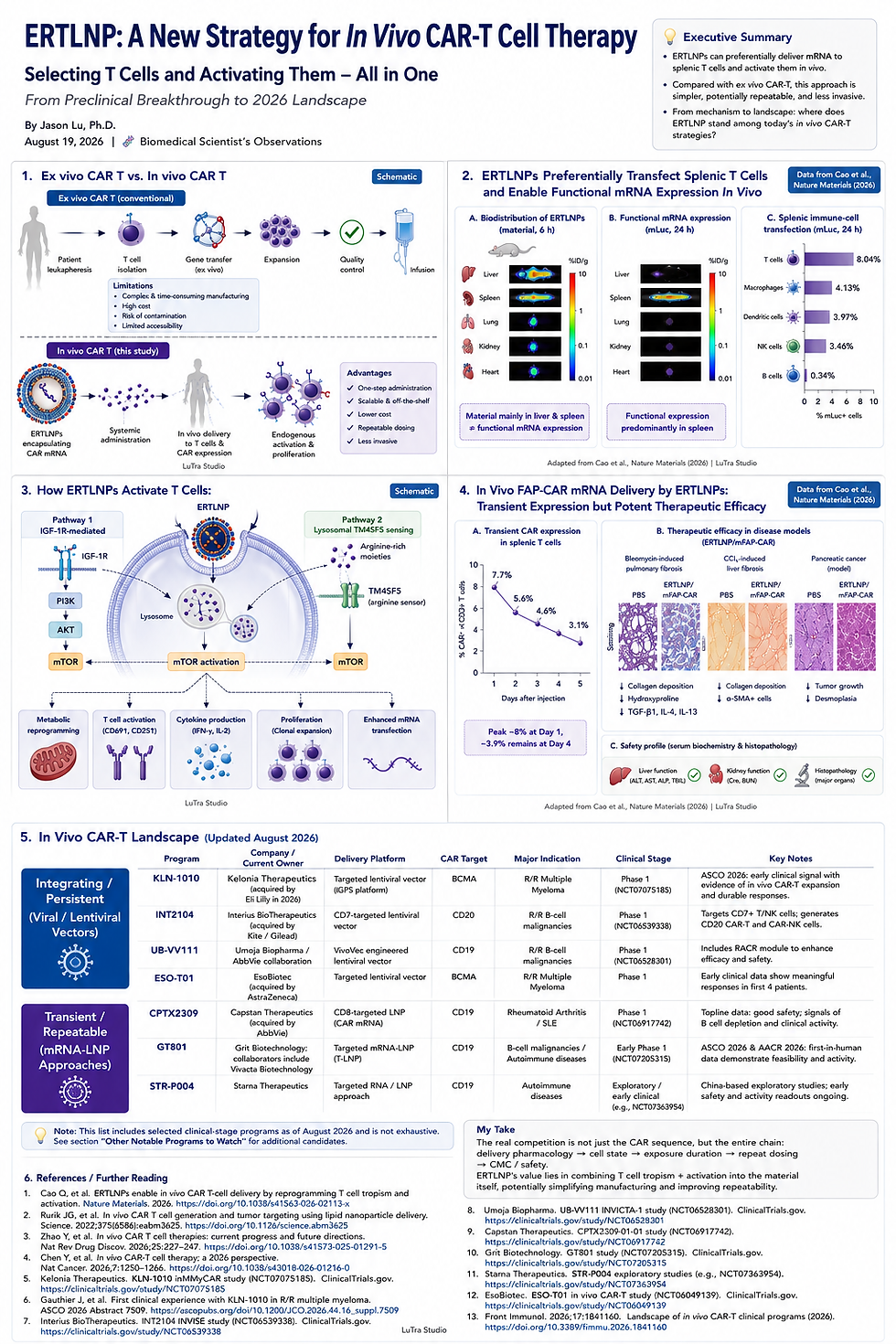
This article continues LuTra Studio's earlier coverage of clinical in vivo CAR-T and non-viral ERTLNP mRNA delivery. The focus here is different. It is not another overview of how to eliminate ex vivo manufacturing. It is an examination of in vivo CAR-NK as a therapeutic design problem: why CARs are moving beyond T cells, how CAR immunotherapy actually works, which disease indications fit each cell chassis, and what this paper does—and does not—show.
In vivo CAR-NK: key takeaways
The study uses NKG2D- and NKG2A-directed LNPs to deliver CAR mRNA into NK cells in mice and humanized mouse models. It is preclinical proof of concept, not evidence of efficacy in patients.
NKG2D-directed LNPs produced higher NK-cell transfection, whereas NKG2A-directed delivery may also influence checkpoint signaling in Qa-1b/HLA-E-rich settings.
Moving CARs from T cells into NK cells, macrophages, or regulatory T cells is not simply an attempt to replace CAR-T; it matches different cell chassis to different immune jobs.
Dedicated, NK-selective, non-viral in vivo CAR-NK has not entered human testing. INT2104 can generate both CAR-T and CAR-NK cells in vivo, but it is not an NK-selective platform.
Why CAR therapy began with T cells
A chimeric antigen receptor is a synthetic receptor that redirects an immune cell toward a chosen surface antigen. CAR-T became the first successful form because T cells already possess several useful properties: potent cytotoxicity, antigen-driven expansion, the ability to form memory, and a mature foundation of culture, gene-transfer, and clinical-manufacturing methods.
CD19 also offered an unusually favorable starting point. It is broadly expressed across several B-cell malignancies, while the expected destruction of normal B cells can be monitored and managed clinically. This combination helped CAR-T establish durable efficacy in selected leukemias and lymphomas and later expanded the modality to BCMA-positive multiple myeloma.
Success, however, also exposed the boundaries of the T-cell chassis.
Most solid tumors remain difficult because engineered T cells must traffic into tumor tissue, penetrate stroma, survive hypoxia and nutrient stress, resist inhibitory signals, and cope with antigen heterogeneity. Potent expansion and persistence can also contribute to cytokine release syndrome, neurotoxicity, and prolonged on-target effects. For allogeneic products, conventional alpha-beta T-cell biology introduces additional concerns around graft-versus-host disease, host rejection, and the need for further genome engineering.
More fundamentally, different diseases require different immune jobs. Killing a circulating B cell, entering a solid-tumor stroma, clearing a pathogenic T-cell population, and restoring antigen-specific tolerance are not equivalent tasks. Moving CARs into NK cells, macrophages, gamma-delta T cells, NKT cells, or regulatory T cells is therefore not a race to replace CAR-T. It is an attempt to match receptor specificity with the native behavior of the most appropriate cell.

Cell chassis | Native advantage | Potential fit | Main development challenge |
Alpha-beta T cell | Strong cytotoxicity, expansion, and memory; deepest clinical experience | B-cell malignancies, multiple myeloma, and emerging autoimmune indications | CRS/ICANS, exhaustion and trafficking in solid tumors, allogeneic compatibility |
NK cell | CAR-dependent plus innate killing; less dependent on classical HLA matching; generally shorter-lived response | T-cell malignancies, rapid immune reset, and potentially off-the-shelf therapy | Limited persistence, difficult non-viral engineering, suppressive microenvironments |
Macrophage/monocyte | Tumor infiltration, phagocytosis, antigen presentation, and stromal remodeling | Solid tumors in which access and microenvironment remodeling matter | Phenotypic plasticity, scalable manufacturing, inflammatory safety |
Gamma-delta T or NKT cell | Innate-like recognition, cytotoxicity, and reduced dependence on conventional HLA restriction | Allogeneic products and selected blood or solid tumors | Population heterogeneity, expansion standards, limited clinical evidence |
Regulatory T cell | Localized immune suppression and tissue tolerance rather than killing | Autoimmune disease, transplantation, and graft-versus-host disease | Phenotypic stability, persistence, and the risk of excessive immunosuppression |
How CAR immunotherapy works
Conventional T-cell receptors recognize peptides presented by HLA/MHC molecules. A CAR usually uses an antibody-derived binding domain to recognize an antigen directly on the target-cell surface. This bypasses classical antigen presentation, but it creates a hard constraint: the target must be accessible on the cell membrane and must offer a sufficient expression window between diseased and essential normal tissue.
A CAR response can be understood as four connected steps.
Recognition and contact. A single-chain variable fragment or another binding domain engages the target antigen. Antigen density, affinity, epitope position, and hinge length influence whether the immune cell can form an effective synapse.
Signal initiation. Antigen binding clusters intracellular signaling domains. First-generation CARs mainly used CD3-zeta; second-generation designs added one costimulatory domain such as CD28 or 4-1BB; later constructs may combine costimulation, cytokine support, checkpoint resistance, logic gates, or safety switches. A newer generation number does not automatically mean a better therapy—the signal must fit the cell and indication.
Effector function. Activated CAR-T or CAR-NK cells release perforin and granzymes, induce target-cell death, secrete cytokines, and recruit broader immunity. NK cells retain additional activating and inhibitory receptors, so their activity is not limited to the CAR alone.
Expansion, persistence, or shutdown. Integrating vectors can support long-lived CAR expression and immune surveillance. Messenger RNA is degraded, making expression transient and potentially easier to control, but often requiring repeat dosing.
The clinical phenotype is therefore not determined by the antigen alone. It emerges from the target, receptor architecture, cell chassis, expression duration, delivery route, and disease microenvironment.
Six design controls turn a CAR construct into a medicine
Design layer | The development question | What can go wrong? |
Target antigen | Is it surface-accessible, sufficiently abundant, and acceptably restricted? | Antigen escape or on-target/off-tumor injury |
Binding domain and hinge | Do affinity, epitope geometry, and spacing support a productive synapse? | Weak activity, tonic signaling, exhaustion, or unintended recognition |
Intracellular signaling | Which activation and costimulatory modules suit this cell chassis? | Insufficient activation or excessive cytokine signaling and dysfunction |
Cell chassis | Does the cell's native behavior match the disease task? | The cell reaches the target but performs the wrong immune function |
Payload and persistence | Is cytokine support needed? Should expression be transient, integrated, or switchable? | Early relapse from insufficient persistence or toxicity that is difficult to stop |
Delivery and biodistribution | Which cells and organs receive the payload, and can treatment be repeated? | CAR expression in unintended cells, tissue accumulation, or loss of redosing activity |
The new NK-targeted LNP platform brings several of these controls into one injection. The particle first binds an NK-cell receptor and enters the cell. Its mRNA reaches the cytosol and is translated into a CAR that appears temporarily on the cell surface. The CAR then redirects killing toward CD19, CD3, or CD7, depending on the payload.
The key advance is that the delivery receptor may also influence the biology of the engineered NK cell.

Why NK cells are a compelling next chassis
NK cells already integrate activating and inhibitory cues to detect stressed or abnormal cells. A CAR adds antigen specificity without removing this innate recognition network. In principle, that gives CAR-NK cells more than one route to detect a heterogeneous target.
Their relatively short-lived effector response may also pair naturally with transient mRNA expression. For an immune-reset strategy, a powerful but reversible treatment window could be preferable to indefinite CAR persistence. The same feature may be a disadvantage when durable tumor surveillance is required.
T-cell malignancies present another strong rationale. Targeting T-lineage antigens such as CD3, CD5, or CD7 with conventional CAR-T can trigger fratricide because the therapeutic cells may express the target themselves. NK cells avoid this issue most clearly when the antigen is absent from NK cells—for example, CD3. The advantage is not universal: human NK-cell subsets can express CD7, so anti-CD7 CAR-NK development may still require careful assessment of subset composition, activation state, and fratricide risk.
Engineering NK cells is not easy. They are typically less permissive to non-viral delivery than T cells and possess strong antiviral sensing. A useful platform must therefore deliver enough payload without damaging the very effector function it aims to exploit.
How the study was designed
The team constructed 24 NK-targeting ligands against NKG2A, NKG2D, KLRG1, and NKp46: eight monovalent, four biparatopic, and twelve bispecific formats. The nanoparticles used the ionizable lipid SM-102, while sortase A enabled site-specific attachment of single-chain antibody fragments to the particle surface.
Two biparatopic constructs emerged from the screen:
BiNKG2D-LNP favored high NK-cell transfection. In mouse validation experiments, NK-cell transfection in some blood and tissue compartments approached 80%.
BiNKG2A-LNP produced lower transfection in several settings—approximately 60% at the reported validation dose—but could perform better when inhibitory NKG2A-ligand biology mattered.
Both showed strong NK preference relative to untargeted controls, with limited expression in several off-target populations. Limited is not zero, and mouse biodistribution cannot establish human cell specificity.
Result 1: transient anti-CD19 CAR expression produced deep B-cell depletion
After intravenous delivery of anti-CD19 CAR mRNA, CAR expression on NK cells was detectable by six hours, peaked around 24 hours, remained visible at 48 hours, and became nearly undetectable by approximately 72 hours in the anti-CD19 time-course experiment.
That short expression window was sufficient for a strong pharmacodynamic effect. Circulating B cells were completely depleted. In the spleen, BiNKG2A treatment reduced B cells by more than 85%, while BiNKG2D produced complete depletion in the reported experiment.
This does not mean that every payload on the platform will share an identical 72-hour profile. Nor does disappearance of measurable CAR protein mean that all downstream biological effects stop at that moment. The more defensible conclusion is that transient CAR expression can initiate a much longer-lived change in the target-cell compartment.
Result 2: anti-CD3 CAR-NK improved a mouse model of autoimmune hepatitis
The researchers next co-delivered anti-CD3 CAR and mouse IL-15 mRNA in an autoimmune-hepatitis model. Animals received three doses at three-day intervals. Both targeted LNPs normalized liver enzymes and reduced tissue injury, while BiNKG2A produced nearly complete depletion of hepatic CD3-positive T cells.
This is an important proof of concept for T-cell-directed immune reset, but its interpretation requires care. An anti-CD3 CAR does not selectively recognize autoreactive clones. It depletes a broad CD3-positive T-cell population in the model. Translating this strategy would therefore require deliberate control of depletion depth, duration, infection risk, immune reconstitution, and the clinical context in which broad T-cell removal could be justified.
Result 3: NKG2A targeting may combine delivery with checkpoint relief
The clearest mechanistic contrast appeared in a solid-tumor experiment using B16F10 melanoma cells engineered to express human CD19. BiNKG2A-LNP carrying anti-CD19 CAR and IL-15 mRNA controlled tumor growth more effectively than BiNKG2D-LNP. Most treated mice reached complete response, with no detectable recurrence through day 100 in the reported follow-up.
BiNKG2A did not simply generate more CAR-NK cells. The tumors instead showed evidence consistent with greater NK-cell activation and cytotoxic function. Because NKG2A transmits inhibitory signals after recognizing Qa-1b in mice or HLA-E in humans, binding this receptor during delivery may partially alter that inhibitory axis.
This suggests a context-dependent design rule:
Where inhibitory-ligand pressure is low, maximizing transfection through NKG2D may be advantageous.
Where Qa-1b/HLA-E is high, NKG2A-directed delivery may combine payload entry with checkpoint modulation.
The experiment remains an engineered-antigen model. B16F10 melanoma does not naturally establish CD19 as a clinically relevant solid-tumor target, and the result does not validate treatment of unmodified human melanoma.
What the humanized mouse models add
In NSG-IL-15 mice carrying human Raji lymphoma, five doses of BiNKG2D-LNP generated anti-CD19 CAR expression in approximately 63% of human NK cells and in fewer than 10% of human T cells. All five treated animals achieved complete remission.
The study also tested CD7-positive CCRF-CEM T-cell leukemia. Before inoculation, the tumor cells were treated with interferon-gamma to increase HLA-E expression, creating a model favorable for testing the NKG2A/HLA-E hypothesis. A human-optimized BiNKG2A-LNP delivering anti-CD7 CAR mRNA produced rapid tumor regression after two injections and complete responses in three of five animals, outperforming the NKG2D-directed formulation in that experiment.
This model detail matters. The result supports the proposed mechanism under HLA-E-high conditions; it does not prove the same advantage across unselected T-cell leukemias.
The humanized experiments show that the platform can generate functional human CAR-NK cells inside a mouse. They do not establish human pharmacokinetics, biodistribution, repeat-dose safety, or clinical efficacy.
Indication selection: match the target to the immune job
Indication or strategy | Why it may fit | Rational chassis or design | Evidence boundary |
CD19-positive B-cell leukemia/lymphoma | Accessible lineage antigen; B-cell aplasia can be monitored and managed | CAR-T when durable expansion is desired; CAR-NK when a shorter or allogeneic profile is attractive | Approved ex vivo CAR-T exists. This paper provides mouse and humanized-mouse CAR-NK evidence only |
BCMA-positive multiple myeloma | A validated plasma-cell-lineage target | CAR-T is clinically mature; in vivo CAR-T is entering early clinical testing | Not an indication tested by this NtLNP paper |
CD3-, CD5-, or CD7-positive T-cell malignancy | Clear targets, but conventional CAR-T may attack itself or normal T cells | CAR-NK, with target-expression and fratricide assessed for each antigen | Anti-CD7 efficacy was shown in an IFN-gamma-induced HLA-E-high humanized model; no human NtLNP data |
B-cell-driven autoimmune disease | Deep B-cell depletion may reset a pathogenic immune compartment | Transient CD19/BCMA in vivo CAR could aim for sufficient reset without unnecessary persistence | Human signals exist for CAR-T approaches; this paper showed B-cell depletion, not efficacy in a B-cell-autoimmune model |
T-cell-driven autoimmune disease | Pathogenic T-cell populations can be directly depleted | Transient CAR-NK may offer exposure control and avoid CD3-directed CAR-T fratricide | The paper improved a mouse hepatitis model through broad CD3-positive T-cell depletion, not clone-selective therapy |
HLA-E-high tumor | NKG2A/HLA-E may suppress NK function, creating a biomarker rationale | NKG2A-directed CAR-NK plus a genuine tumor antigen and appropriate trafficking design | Mechanistic and preclinical rationale only; the solid-tumor experiment used engineered CD19 |
The most plausible first opportunities are not necessarily indications where CAR-NK replaces a successful CAR-T product. They may be settings in which the cell chassis solves a specific problem: T-lineage targets that complicate CAR-T manufacturing, diseases where a temporary immune reset is preferable, or biomarker-selected tumors in which the NKG2A/HLA-E axis is a meaningful source of suppression. These are development hypotheses, not clinical conclusions from the paper.
What remains unresolved
1. Every efficacy result is preclinical
There were no treated patients. Humanized mice do not reproduce a complete human immune system, and the NSG-IL-15 background is specifically supportive of human NK-cell survival.
2. Transience is both a safety feature and a dosing burden
Short-lived expression may improve control, but cancer or chronic immune disease may require repeated dosing. Repeat administration was tolerated in the reported mouse experiments. Anti-scFv antibody titers increased, although the authors did not observe significant neutralization during the tested interval. This does not predict long-term redosing in humans.
3. The ex vivo comparator was not fully matched
In the humanized lymphoma experiment, the ex vivo CAR-NK comparator included an IL-15/IL-15R-alpha support module that was absent from the human CAR delivered by NtLNP. The comparison is a useful model benchmark, not a clinical non-inferiority test against an existing CAR-NK product.
4. NKG2A is biologically active, not a neutral delivery handle
Checkpoint relief may improve function, but manipulating an inhibitory receptor could also affect NK-cell education, homeostasis, and tissue-specific behavior. Patient-to-patient variation in HLA-E expression and NK-cell subsets will matter.
5. Translation moves product control into the patient
Ex vivo manufacturing measures cell identity, transduction, dose, viability, potency, and release quality before infusion. In vivo engineering must control many of those variables indirectly through biodistribution, receptor abundance, payload exposure, and patient biology. Eliminating the factory does not eliminate manufacturing risk; it relocates part of product formation into the body.
The authors reported funding from Sanofi (formerly Translate Bio), the Marble Center for Cancer Nanomedicine, and an NCI core grant, as well as patent applications and relevant competing interests. These disclosures do not invalidate the experiments, but they belong in the translational context.
Where academia and industry stand
The in vivo CAR field is advancing at different speeds depending on the cell and delivery modality.
Academic work has progressed from early DNA nanocarriers and CD5-directed mRNA-LNP approaches to enveloped delivery vehicles, targeted viral vectors, site-specific genome integration, activation-responsive LNPs, and now NK-selective ligand-directed nanoparticles. The question has shifted from “Can a CAR cell be generated in vivo?” toward “Can we control cell identity, expression duration, genomic location, functional state, and repeat dosing?”
Industry is furthest ahead with in vivo CAR-T. Multiple viral and non-viral programs have entered or approached Phase 1 testing. One relevant bridge to NK biology is Interius's INT2104, a CD7-targeted lentiviral vector designed to generate anti-CD20 CAR-T and CAR-NK cells in vivo. It is being studied in the Phase 1 INVISE trial (NCT06539338), which was listed as active, not recruiting with a target enrollment of 10 in the September 8, 2026 registry update. However, INT2104 is not an NK-selective product, and publicly available human evidence does not yet isolate the independent contribution of CAR-NK cells.
Dedicated non-viral, NK-selective in vivo CAR-NK remains preclinical. By contrast, ex vivo cord-blood, donor-derived, and iPSC-derived CAR-NK products have accumulated human trial experience, but they address off-the-shelf cell manufacturing rather than direct engineering inside the patient.
The most accurate summary as of October 17, 2026 is:
In vivo CAR-T has reached early clinical validation across several platforms. In vivo CAR-NK has now achieved an important non-viral, NK-selective preclinical proof of concept—but not yet human validation.

A reality check from the first in vivo CAR-T clinical stories
Extended follow-up of four patients treated with the in vivo BCMA CAR-T candidate ESO-T01 illustrates the gap between mechanism and durable therapy. All four achieved an objective response, but median progression-free survival was four months. One patient maintained a stringent complete response for 15 months, while three experienced relapse or progression.
That result does not negate the platform. It clarifies the next standard of evidence. Generating CAR-positive cells is proof of mechanism. Achieving reproducible cell fitness, trafficking, persistence, safety, and durable patient benefit is proof of therapy.
The same discipline should be applied to this CAR-NK paper. An NK-cell transfection rate approaching 80% is technically striking, but the clinically important questions are what those cells do in different human disease environments, how long the effect lasts, and whether redosing remains effective and tolerable.
What this paper changes
First, it expands the in vivo CAR map beyond T cells with a credible NK-selective delivery strategy.
Second, it shows why delivery efficiency cannot be the only optimization metric. The best-performing receptor may be the one that combines uptake with beneficial immune signaling—not simply the one that produces the most CAR-positive cells.
Third, it reinforces that transient does not mean biologically weak. A short pulse of CAR expression can cause deep depletion of a target-cell compartment. Whether that is an advantage or a limitation depends on the indication.
Finally, it raises the bar for platform modularity. A mature in vivo CAR medicine will need to co-optimize:
immune-cell targeting ligand;
vector or LNP composition;
CAR architecture and supporting payload;
receptor-signaling biology;
tissue biodistribution;
expression duration and redosing strategy; and
a disease-specific pharmacodynamic endpoint.
Conclusion: from manufacturing in vivo to designing immunity in vivo
The first in vivo CAR question was whether the patient could become the CAR-cell factory. This study asks what happens after that factory moves inside the body: can we choose the cell, tune its state, and define how long the product exists?
The answer is beginning to look like yes—but only in preclinical models so far.
This Nature Biotechnology paper is important because it treats the targeting receptor as part of the pharmacology rather than as a delivery label. NKG2D may favor transfection; NKG2A may offer less uptake but more functional benefit in an inhibitory-ligand-rich context. That is a meaningful conceptual advance.
The true milestone will not be a single high percentage of CAR-positive NK cells. It will be the ability to generate the intended cell product across different patients with predictable specificity, acceptable toxicity, sufficient tissue activity, repeatable dosing, and durable clinical benefit.
If that can be achieved, in vivo CAR will change more than how CAR-T or CAR-NK is manufactured. It will change how a cell-therapy product is defined.
In vivo CAR-NK FAQ
What is in vivo CAR-NK?
In vivo CAR-NK delivers a CAR genetic payload directly to NK cells inside the body, allowing a patient's own NK cells to express a CAR temporarily or durably. The NtLNP platform in this study uses mRNA, so CAR expression is transient and non-integrating.
Has in vivo CAR-NK entered human trials?
As of October 17, 2026, dedicated, NK-selective, non-viral in vivo CAR-NK remains preclinical. INT2104 is in Phase 1, but it generates both CAR-T and CAR-NK cells and therefore does not constitute NK-selective human validation.
How do NKG2D- and NKG2A-directed LNPs differ?
In this study, NKG2D-directed LNPs produced higher NK-cell transfection. NKG2A-directed LNPs generated fewer CAR-positive NK cells but may improve function in tumors with abundant NKG2A ligand by altering inhibitory signaling. That interpretation remains context-dependent and preclinical.
About LuTra Studio
LuTra Studio helps science-driven teams translate complex technologies into actionable development, CMC, market-positioning, and partnering strategies. We follow in vivo cell engineering not simply because it may shorten a manufacturing workflow, but because it redistributes risk across delivery, cell biology, product control, and clinical development.
References
Chen Y, Monkovic J, Mughal H, et al. In vivo engineering of CAR natural killer cells for immunotherapy using ligand-directed lipid nanoparticles. Nature Biotechnology. 2026.
Smith TT, Stephan SB, Moffett HF, et al. In situ programming of leukaemia-specific T cells using synthetic DNA nanocarriers. Nature Nanotechnology. 2017.
Rurik JG, Tombacz I, Yadegari A, et al. CAR T cells produced in vivo to treat cardiac injury. Science. 2022.
Hamilton JR, Chen E, Perez BS, et al. In vivo human T cell engineering with enveloped delivery vehicles. Nature Biotechnology. 2024.
Hunter TL, et al. In vivo CAR T cell generation to treat cancer and autoimmune disease. Science. 2025.
Wang Q, Xiao ZX, Zheng X, et al. In Vivo CD19 CAR T-Cell Therapy for Refractory Systemic Lupus Erythematosus. New England Journal of Medicine. 2025.
In vivo site-specific engineering to reprogram T cells. Nature. 2026.
Xu J, Liu L, Xie W, et al. Extended follow-up of in vivo BCMA CAR-T therapy in relapsed/refractory multiple myeloma. Nature Medicine. 2026.
Gilead Clinical Trials. INVISE Phase 1 study of INT2104, NCT06539338. Accessed October 17, 2026.
Dagher OK, Posey AD Jr. Forks in the road for CAR T and CAR NK cell cancer therapies. Nature Immunology. 2023.
Alrehaili M, et al. CAR-macrophages in solid tumors: promise, progress, and prospects. npj Precision Oncology. 2025.
Ferreira LMR, Muller YD, Bluestone JA, Tang Q. Next-generation regulatory T cell therapy. Nature Reviews Drug Discovery. 2019;18:749–769.
Harnessing the potential of gamma-delta T cells through engineering and combination treatment for cancer therapies. Nature Communications. 2026.
National Cancer Institute. CAR T Cells: Engineering Immune Cells to Treat Cancer. Accessed October 17, 2026.
U.S. Food and Drug Administration. Approved Cellular and Gene Therapy Products. Accessed October 17, 2026.
CAR-T cell therapy for cancer: current challenges and future directions. Signal Transduction and Targeted Therapy. 2025.
Abbreviations
BCMA: B-cell maturation antigen
CAR: Chimeric antigen receptor
CMC: Chemistry, manufacturing, and controls
CRS: Cytokine release syndrome
GvHD: Graft-versus-host disease
HLA-E: Human leukocyte antigen E
ICANS: Immune effector cell-associated neurotoxicity syndrome
LNP: Lipid nanoparticle
MHC: Major histocompatibility complex
NK cell: Natural killer cell
NtLNP: NK-cell-targeted lipid nanoparticle
PFS: Progression-free survival
scFv: Single-chain variable fragment
sCR: Stringent complete response
TCR: T-cell receptor


Comments