

Biologics Cell Bank Characterization: CMC Series XI—ICH Q5D, MCB/WCB, Genetic Stability, and Cell Substrate Control

A master cell bank (MCB) has passed identity, sterility, mycoplasma, and adventitious-agent testing. Does that mean the bank is fully qualified to support clinical development and commercial manufacturing?
Not necessarily.
Test results show whether defined samples met expectations using specified methods with known detection capabilities. They do not, by themselves, establish where the cells came from, whether their derivation is traceable, whether the proposed production cell age is justified, whether the expression construct remains stable, or whether cells retain consistent manufacturing performance after long-term storage.
That is the central idea of Biologics Cell Bank Characterization: the objective is not to complete an assay panel. It is to build a coherent body of evidence for origin, identity, purity, stability, and manufacturing suitability.
ICH Q5D reached Step 4 in 1997 and describes the derivation, characterization, and management of cell substrates used to produce biotechnology and biological products. ICH Q5B complements it for recombinant DNA-derived protein products by addressing the expression construct and genetic stability. Together, they connect cell lineage, MCB/WCB architecture, cell age, nucleic-acid data, and actual product quality.

From cell-substrate origin and derivation through the MCB, WCB, and production cells, characterization establishes a traceable, reproducible, and manufacturing-suitable system. LuTra Studio
The core of Biologics Cell Bank Characterization: not an assay checklist
A mature cell-bank strategy should answer at least six questions:
What is the origin, history, and derivation of the cell substrate?
Are the identity, purity, and contamination risks of the MCB and WCB controlled?
Do the cells retain acceptable manufacturing characteristics throughout the proposed cultivation period?
Do the expression construct and coding sequence remain consistent at an appropriate cell age?
After long-term storage, can banked cells recover, grow, and produce the intended product?
Do a new bank, process change, or site transfer alter the original risks and evidence?
Biologics Cell Bank Characterization is therefore more than “full testing for the MCB and reduced testing for the WCB.” The control strategy must integrate prevention, testing, traceability, storage, manufacturing experience, and lifecycle change management.
Start with scope: Q5D is not a universal template for every cell-based product
ICH Q5D primarily addresses microbial cells and cell lines of human or animal origin maintained through a cell-banking system, including continuous and diploid cell lines. The guideline also states that cell banks used for gene therapy or vaccine production should follow its recommendations.
Primary cells, however, are generally not maintained through a conventional banking system and are not directly addressed by Q5D. Appendix 1 provides some considerations, but a traditional recombinant-protein MCB/WCB package should not be transferred unchanged to every primary-cell or cell-therapy product.
Likewise, FDA's 2010 cell-substrate guidance specifically focuses on prophylactic viral vaccines. Its additional considerations should not be generalized into universal requirements for all biologics. The product type, presence or absence of cells in the final product, purification strategy, process risks, and applicable regional requirements should be defined before the characterization plan is selected.
Cell-lineage history: establish “what it is” before listing “what was tested”
One of the most underestimated parts of a cell-bank dossier is not an assay—it is the history.
A reviewable lineage should document:
the species, tissue origin, and method used to obtain the starting cells
donor or source-material information and relevant ethical or biosafety considerations
isolation, adaptation, immortalization, or transformation history
the expression vector, host cell, and transfection or transformation method
selection markers, clone selection, subcloning, and amplification history
exposure to serum, trypsin, growth factors, or other human- or animal-derived materials
culture media, passage history, vessels, and critical culture conditions
the lineage relationship among pre-MCB, MCB, WCB, and production cells
These data establish provenance and a risk map. If poorly defined animal-derived materials were used early in development, a large set of negative tests does not erase that history. The team must explain how the risk was assessed, which controls reduce it, and how residual uncertainty is managed.

The cell-lineage history connects source, gene transfer, clone selection, culture history, and material exposure into a traceable risk map. LuTra Studio
The two-tier MCB/WCB system controls variability and supply—not just inventory
ICH Q5D describes a two-tiered banking system as a generally accepted practical approach: a well-characterized MCB is used to establish one or more WCBs, and production campaigns begin from WCB vials.
This architecture can:
limit repeated handling of the MCB and reduce depletion, contamination, and mix-up risks
provide a controlled and consistent starting point for routine manufacturing
keep production cell age within a studied range
support comparability across lots, sites, and time
maintain sufficient inventory and a disaster-recovery strategy
The MCB normally receives more extensive identity, purity, and other applicable characterization. A WCB usually receives purity testing and more limited identity confirmation. This is not an immutable minimum list. A company may justify performing selected characterization mainly at the WCB or using another banking architecture, but it should explain sample representativeness, the relationship between banks, and the associated risk controls.
Even when an external supplier, academic laboratory, or partner established the cell bank, the product manufacturer remains responsible for its quality and suitability. A certificate of analysis does not replace an understanding of source records, test methods, sample representativeness, and supporting data.

In a two-tier system, the MCB preserves the long-term reference while WCBs support routine manufacturing and keep production cells within the studied cell-age range. LuTra Studio
The characterization matrix: identity, purity, stability, and suitability answer different questions
Cell-bank testing should not begin with a panel copied from another product. It should begin by defining the risk question that each test is intended to answer.
Identity: confirm the cell and its lineage relationship
An identity method should distinguish the intended cell line from other cells that could plausibly be confused with it. Depending on the substrate, methods may include morphology, species-specific analysis, isoenzyme analysis, STR profiling, genotype, or another suitable approach. The goal is not to maximize the number of assays; it is to demonstrate adequate discriminatory power.
Purity: no single testing regimen detects every contaminant
A purity program may include sterility, mycoplasma, bacterial or fungal contamination, and risk-based adventitious-agent testing. ICH Q5D explicitly recognizes that no testing regimen can detect every potential contaminant. Preventive controls during banking are therefore equally important: a controlled environment, closed or appropriately segregated operations, material controls, labeling and traceability, and procedures that prevent cross-contamination.
Suitability: can the cells consistently support the intended process and product?
Suitability is more than acceptable viability. The assessment may include post-thaw recovery, growth, productivity, critical product quality attributes, and phenotypes relevant to process performance. Karyology, tumorigenicity, or other studies may be appropriate when the cell substrate or product warrants them; they are not blanket requirements for every highly purified, cell-free biotechnology product.
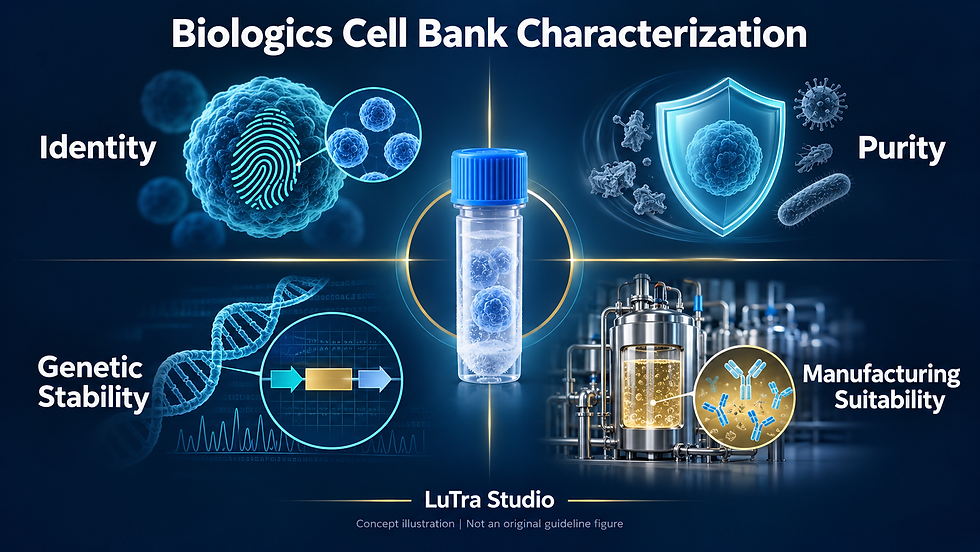
A characterization matrix should map each assay to a defined risk question instead of deriving the strategy from a universal test list. LuTra Studio
Cell age: study the production window, not only freshly thawed cells
ICH Q5B describes in vitro cell age as the period from MCB thaw through harvest from the production vessel. Depending on the system, it may be expressed as elapsed time, population doublings, or passage level. This matters because the evidence must support more than the condition of the initial vial. It must show that cells remain suitable after completing the proposed expansion and production process.
A common strategy compares:
early-stage or minimally subcultured cells
cells at or beyond the proposed limit of in vitro cell age (LIVCA)
when appropriate, end-of-production cells (EOPC) or representative production-scale material
The cell-age limit should be supported by representative pilot- or commercial-scale cultivation, rather than inferred only from small shake-flask passage numbers. A change to the seed train, scale, culture duration, perfusion strategy, or passage definition may require the original cell-age rationale to be reassessed.
ICH Q5B genetic stability: DNA results and product data should complement one another
For a recombinant protein-producing line, the objective of genetic-stability assessment is not to prove that every cell remains molecularly identical forever. It is to show that the expression construct and product performance remain acceptable throughout the proposed manufacturing period.
Depending on the product and system, the assessment may include:
consistency of the coding sequence
copy number or meaningful structural changes
insertions, deletions, or integration patterns
retention of an extrachromosomal construct
transcript or expression levels
product identity, purity, potency, glycosylation, or other critical quality attributes
trends in productivity and process performance
The important Q5B boundary is that nucleic-acid analysis can confirm the coding sequence and physical state of the expression construct, but it cannot by itself establish translational fidelity, higher-order structure, or post-translational modifications. Conversely, an in-specification protein result may not replace an appropriate assessment of construct stability.
The strongest strategy aligns nucleic-acid data, cellular phenotype, productivity, and purified-product characterization from early and LIVCA or EOPC samples.
Banking, filling, and storage: testing cannot rescue an uncontrolled banking operation
A cell bank is generally filled from a homogeneous pooled cell suspension so that containers represent the same banking event. Records should capture cell concentration, viability, containers, labels, freezing conditions, locations, and inventory movements while preserving chain of identity.
A storage strategy involves more than setting a liquid-nitrogen temperature. It should address:
suitability of the storage container and closure
temperature monitoring, alarms, and back-up power
inventory control and restricted access
management of excursions, thaw events, and container damage
disaster recovery through primary and remote or redundant storage
a monitoring plan for long-term viability, recovery, and manufacturing capability
Storage stability should focus on whether cells can recover and support the intended manufacturing process—not only whether a frozen vial meets a viability value at a particular time point.
Case example: can a new WCB be released with only sterility and mycoplasma testing?
Suppose a company creates a second WCB from the same MCB using the same medium, banking procedure, site, and storage system. Is sterility and mycoplasma testing enough to treat it as equivalent to the original WCB?
The answer cannot be determined by test count alone. A more useful assessment asks:
Is the new WCB demonstrably derived from the same MCB with complete lineage and chain-of-identity records?
Are expansion, raw materials, equipment, site, and cryopreservation process unchanged?
Do the new bank's identity, purity, and recovery meet established criteria?
Could it affect the seed train, cell age, productivity, or product quality?
Does manufacturing history support a reduced repeat-characterization package?
Are an engineering run, comparability data, or additional bridging needed?
Testing may be risk-based when origin and process are highly consistent and historical evidence is strong. However, derivation from the same MCB is not an automatic waiver. A change to site, medium, cryoprotectant, freezing profile, or storage container should trigger a reassessment of the original assumptions.
CTD Module 3: organize cell-bank data as a traceable quality argument
Cell-substrate and cell-banking information is not confined to one isolated CTD paragraph. In practice, the evidence may connect to:
3.2.S.2.3 Control of Materials: cell-substrate origin, history, banking system, characterization, and raw-material controls
3.2.S.2.6 Manufacturing Process Development: clone or bank selection, the cell-age limit, process-development rationale, and significant changes
3.2.A.2 Adventitious Agents Safety Evaluation: evidence related to cell banks, raw materials, unprocessed bulk, and viral safety
3.2.S.2.2 Description of Manufacturing Process and Process Controls: the process from WCB thaw through the seed train and harvest, including in-process controls
Exact placement should still reflect the product, region, and effective CTD guidance. Importantly, M4Q(R2) remained a draft under public consultation at the time of this review; draft content should not be represented as a globally effective final format.
A strong dossier does more than place reports in the correct sections. It lets a reviewer trace each identified risk to a control, understand which representative sample supports the conclusion, and see how lifecycle changes preserve the original argument.
Lifecycle management: a new bank, technology transfer, or process change can alter the evidence
Events that commonly warrant a documented impact assessment include:
creation of a new WCB or replacement MCB
depletion, loss, deviation, or storage excursion affecting a cell bank
a change to medium, raw material, cryoprotectant, or supplier
a change to the banking site, testing laboratory, storage facility, or manufacturing site
a change to seed train, scale, culture duration, passage definition, or production mode
updates to analytical methods, reference standards, or adventitious-agent strategy
drift in productivity, growth, viability, or product quality
Not every change requires complete repeat characterization. Every relevant change should, however, compare the original assumptions, the scope of the change, representative data, and potential product impact before selecting a paper-based justification, requalification, bridging, comparability study, or new characterization campaign.

Cell-bank control is an ongoing lifecycle program spanning inventory, storage, trending, technology transfer, new banks, and comparability after change. LuTra Studio
This article continues Series X on ICH Q5A(R2) viral safety. That installment explained how source controls, virus testing, and process clearance form a multilayer viral-safety strategy. This article moves upstream to show how the cell substrate itself is derived, characterized, and maintained under control throughout its lifecycle.
Conclusion: the cell bank is both the process starting point and the long-term reference
The most important question in Biologics Cell Bank Characterization is not “How many tests were performed?” It is whether the combined evidence supports a consistent conclusion: the cell substrate has a traceable origin and clear identity, its contamination risks are controlled, and it continues to produce the expected product over the intended cell-age and storage periods.
A mature strategy should explain:
how lineage and material-exposure history establish the risk map
why the MCB/WCB architecture fits the intended process and supply needs
what risk question each identity, purity, stability, and suitability assay answers
how LIVCA or EOPC represents the actual production window
how nucleic-acid and product-level data jointly support genetic stability
how storage, redundancy, and inventory controls protect long-term supply
how new banks, technology transfer, and changes are assessed and documented across the CTD lifecycle
When a cell bank is managed as a continuously maintained quality system rather than a collection of frozen vials, it can serve as a reliable foundation for biologics manufacturing consistency.
LuTra Studio helps biotechnology companies and development teams build phase-appropriate Biologics CMC strategies, including cell-substrate risk assessment, MCB/WCB characterization planning, cell-age and genetic-stability study design, cell-bank comparability, CTD Module 3 evidence mapping, and lifecycle change assessment.
References
Regulatory status checked October 19, 2026 (America/New_York). This article provides general scientific and regulatory information and is not legal, medical, or product-specific submission advice.


Comments