

Biologics Container Closure Systems: CMC Series IX—CCIT, E&L, and Stability

A monoclonal antibody lot passes release testing for appearance, purity, aggregates, particles, and potency. Its long-term stability data also look reassuring. Does that prove the product will maintain its quality throughout shelf life once it is placed in a vial or prefilled syringe?
Not necessarily.
For a biologic, the container closure system (CCS) is not passive packaging around the drug product. It is part of the product system. It influences exposure to oxygen, moisture, light, and microbial challenge. Glass, elastomers, coatings, lubricants, adhesives, silicone oil, and device components can also affect protein adsorption, aggregation, particle formation, potency, and dose delivery.
The right question is therefore not simply whether a vial can hold the product. It is:
Can the container closure system continue to protect the product during manufacturing, shipping, storage, and use without introducing unacceptable quality, safety, or delivery risks for the patient?
In August 2026, FDA issued a new draft guidance, *Container Closure Systems for Human Drugs and Biological Products*, describing a risk-based framework and addressing CCSs that are device constituent parts of combination products. The document remains a draft and is not for implementation. FDA states that it will supersede the 1999 guidance and the 2002 Questions and Answers only when finalized. This article also draws on the emerging ICH Q3E framework for extractables and leachables. As of October 11, 2026, the official ICH page still lists Q3E at Step 3, not as a Step 4 final guideline.
A container closure system is more than a container
A CCS is the complete set of packaging components that together contain and protect a product. For a sterile injectable biologic, it may include:
a glass or polymer vial or syringe barrel
an elastomeric stopper, plunger stopper, or needle shield
an aluminum seal, overseal, or tip cap
coatings, silicone oil, lubricants, and adhesives
administration ports, connectors, or other product-contact delivery components
for some semipermeable systems, secondary packaging, label inks, or adhesives that can affect the product
When the CCS also delivers the dose—or becomes part of a prefilled syringe or autoinjector—it may enter the design, performance, and human-factors assessment of a combination product. Primary packaging, device performance, and drug-product quality should not be managed as unrelated workstreams.

The container closure system is the shared interface among biologic quality, sterile-barrier assurance, and dose delivery. LuTra Studio
Why biologics are especially sensitive to packaging interactions
Proteins are often more sensitive to interfaces and environmental conditions than small molecules. Important risks include:
Protein adsorption: Low-concentration proteins can adsorb to glass, polymer, tubing, or elastomer surfaces, reducing the delivered concentration.
Surface-induced aggregation: Air–liquid, silicone oil–water, and solid–liquid interfaces can promote unfolding and aggregation.
Particles: Silicone oil droplets, glass delamination, tungsten residues, rubber fragments, and other foreign matter may coexist with proteinaceous particles.
Oxygen, moisture, and light: Inadequate barrier properties or headspace control may increase oxidation, hydrolysis, or photodegradation.
Extractables and leachables: Chemicals from packaging or process-contact materials may enter the product and affect patient safety or product quality.
Container closure integrity: A small leak can compromise the sterile barrier or permit gas and moisture exchange beyond the product's acceptable limits.
Dose delivery: Plunger movement, needle shields, break-loose force, glide force, and residual volume may alter the dose actually delivered.
These risks may not be visible at release. They can emerge only after long-term storage, shipping vibration, low-temperature exposure, orientation changes, repeated handling, or actual injection.
A practical framework: Safety, Protection, Compatibility, and Performance
A CCS strategy can be organized around four connected questions.
Safety
Could the materials, additives, residues, extractables, or actual leachables create a toxicological risk? Compliance with a compendial material test is not enough by itself. Route of administration, maximum daily dose, treatment duration, patient population, and actual exposure all matter.
Protection
Can the system resist foreseeable microbial, oxygen, moisture, light, impact, pressure, and temperature challenges? For sterile biologics, this question directly connects CCIT with the stability program.
Compatibility
Does product contact cause adsorption, aggregation, potency loss, pH shifts, particle increases, or other quality changes? Compatibility is bidirectional: the package can affect the product, and the formulation can alter the performance of a closure or coating.
Performance
Can the system be manufactured, sealed, stored, opened, and used as intended? When the system also delivers the dose, the assessment may include dose accuracy, break-loose and glide force, needle protection, connectivity, and in-use integrity.
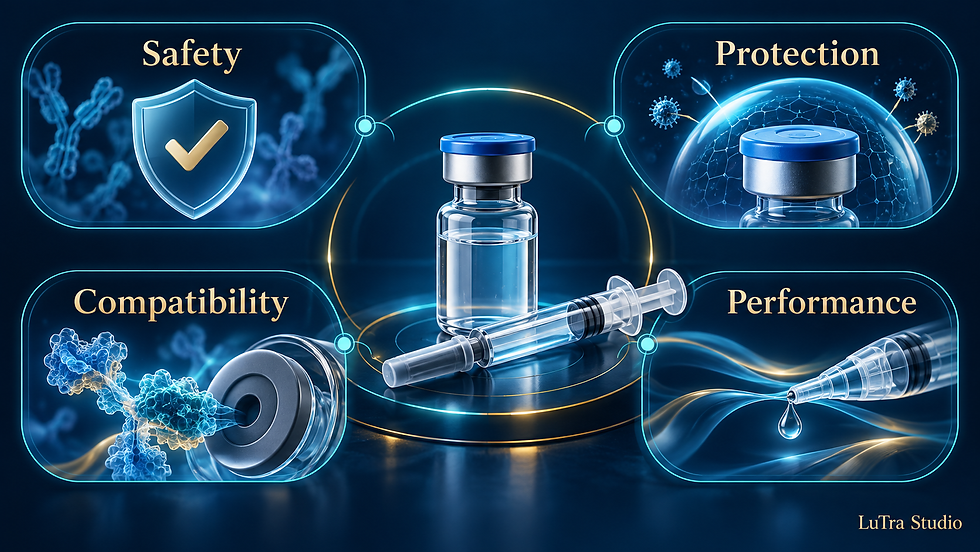
CCS evaluation is an integrated assessment of Safety, Protection, Compatibility, and Performance—not a single test. LuTra Studio
How CCIT differs from sterility testing
Sterility testing asks whether viable microorganisms are detected in the tested samples. Container closure integrity testing asks whether the package maintains the required barrier. These are different questions.
Sterility testing has inherent limitations. It is destructive, examines only sampled units, detects only organisms capable of growth under the specified conditions, and can be affected by contamination introduced during testing. A negative result does not directly prove integrity for an entire lot or throughout shelf life.
FDA's final guidance on stability protocols for sterile products explains that validated container and closure integrity methods can provide more reliable evidence of continuing sterile-barrier integrity and, when appropriately justified, can replace some sterility testing within a stability protocol. This does not eliminate the broader release sterility strategy. It moves the package-integrity evidence toward a more mechanistic test.
CCIT method selection should begin with the maximum allowable leakage limit relevant to the product and package, the required detection range, sample preparation, sensitivity, false-positive and false-negative risks, and the intended use. Methods are often grouped as:
Deterministic methods, such as tracer-gas, vacuum-decay, pressure-decay, high-voltage leak detection, or laser-based headspace analysis. They generally produce a measurable physical signal and can support quantitative performance characterization.
Probabilistic methods, such as microbial ingress or dye ingress. Their outcomes may be more sensitive to operator technique, challenge media, microorganisms, defect geometry, and interpretation.
“Deterministic” does not mean that a method is automatically suitable. The method must detect leaks relevant to the product risk, and validation should represent the actual CCS, expected defect types, aging, shipping, and in-use states.
Extractables, leachables, and the AET
Extractables are chemicals that can be pulled from a material under deliberately exaggerated solvent, time, or temperature conditions. Leachables are chemicals that actually migrate into the product during manufacturing, storage, and use.
The purpose of an extractables study is not to create the longest possible peak list. It is to understand what a material could release, under which conditions, and which compounds need product-specific follow-up. A leachables study should connect to clinical use, maximum dose, shelf life, storage orientation, temperature, in-use period, and the drug-product matrix.
The Analytical Evaluation Threshold (AET) helps determine which analytical signals require identification, quantitation, and assessment. It is not one universal number. It is normally derived from a safety concern threshold, maximum daily dose, number of containers, sample concentration or dilution, analytical uncertainty, and the study design. Reusing a supplier's AET—or an AET from another product—can underestimate patient exposure.
The ICH Q3E draft proposes an integrated framework covering risk assessment, chemical testing, AET, safety assessment, documentation, and lifecycle management. It also groups leachables into Classes 1, 2, and 3 for risk-based evaluation. Until Q3E reaches Step 4, however, teams should treat it as an emerging framework and continue to follow current regional requirements and expectations.

A risk-based path from material knowledge and extractables to product-specific leachables and patient-exposure assessment. LuTra Studio
Vials and prefilled syringes have different risk profiles
For a vial, risks often center on the stopper–seal combination, headspace, coring, fragmentation, glass delamination, closure seating, crimping, and in-use integrity after needle puncture. Storage orientation may also change the extent of product contact with the elastomer.
A prefilled syringe (PFS) integrates more functions into one system. In addition to the barrel, plunger stopper, tip cap, or needle shield, the assessment may need to consider:
interactions among silicone oil, proteins, and particles
tungsten residues from glass-syringe manufacturing
changes in break-loose and glide force over time
effects of plunger movement, air bubbles, and shipping pressure
needle clogging, needle-shield removal, and delivered volume
dimensional tolerances and device performance when combined with an autoinjector
Moving from a vial to a PFS is therefore not a simple packaging change. It can trigger an integrated assessment of formulation compatibility, analytical comparability, stability, CCIT, E&L, device verification, and regulatory reporting.
Connecting CCS to stability, shipping, low temperature, and in-use studies
A complete CCS strategy should not rely on one component qualification package. It should address:
Long-term stability: Does the final commercial system maintain quality and integrity under labeled storage conditions throughout shelf life?
Orientation: Do upright, horizontal, or inverted conditions change closure contact or the leachables profile?
Accelerated and stress studies: Can temperature, humidity, light, or pressure reveal weaknesses in barriers, compatibility, or seals?
Shipping: Do vibration, shock, orientation changes, low pressure, or temperature excursions affect closure seating, particles, or delivery performance?
Freeze–thaw and low temperature: Could differential material contraction create a temporary leak or seal failure?
In-use: During puncture, connection, preparation, dilution, hold time, and administration, does the system maintain integrity, compatibility, and delivered dose?
Ongoing stability: Do annual commercial lots and component changes continue to support the original shelf-life claim?
These studies should support the same claims as the stability program discussed in Series VIII. CCS evidence is not an appendix to stability; it is one of the foundations of shelf life.

Vials and PFSs carry different risks. A presentation change should integrate comparability, stability, CCIT, E&L, and device performance. LuTra Studio
Case example: moving a refrigerated mAb from a vial to a PFS
Consider a monoclonal antibody stored at 2–8°C and already marketed in a vial. The team plans a prefilled-syringe presentation to improve usability. A rational sequence could be:
Define the target product profile and use scenario: dose, concentration, patient population, route, storage, shipping, users, and any planned autoinjector.
Build a material risk assessment covering the barrel, plunger, coatings, silicone oil, needle, adhesive, tungsten, and other direct or indirect contact materials.
Use supplier knowledge and extractables studies to build the chemical target list, without treating a supplier report as the product-specific leachables conclusion.
Design stability and leachables studies using the final formulation, commercial PFS, intended orientation, maximum shelf life, accelerated conditions, and in-use conditions.
Build the particle and protein comparability package, distinguishing proteinaceous particles, silicone oil droplets, and other intrinsic or extrinsic particles.
Develop and validate a CCIT method that represents post-manufacturing, shipping, aging, low-temperature, and use-relevant states.
Assess functional performance, including break-loose and glide force, delivered volume, needle-shield function, injection time, and combined-device performance.
Integrate the regulatory strategy, including impacts on the approved presentation, specifications, shelf life, comparability, and combination-product requirements.
The goal is not merely to complete each study. It is to make every study answer the same set of product risks.
Where the evidence fits in CTD Module 3
Container closure information is distributed across the CTD rather than confined to one section:
3.2.P.2.4 Container Closure System: system selection, development rationale, compatibility, and suitability.
3.2.P.7 Container Closure System: components, materials, specifications, drawings, and supplier-related information.
3.2.P.8 Stability: stability in the proposed market container, orientation, shipping or excursion support, and in-use studies.
3.2.P.5 Control of Drug Product: depending on the strategy, particles, delivered volume, CCIT, or other drug-product controls.
3.2.A or regional sections: facility, device, or other supplementary information as applicable.
E&L study reports, toxicological assessments, CCIT development and validation, and supplier-qualification records should be connected to the main argument through clear cross-references. Reviewers need a traceable risk-to-control evidence chain, not simply a large collection of attachments.
Supplier qualification and lifecycle management
Even if a drawing and release specification do not change, supplier changes to raw-material sources, formulations, processes, molds, coatings, cleaning, sterilization, or manufacturing sites can alter performance or the E&L profile.
A mature lifecycle program should include:
critical material attributes and component specifications
supplier qualification, quality agreements, and change-notification expectations
incoming controls and dimensional or functional trending
reference samples and a bridging strategy when needed
integrated trending of deviations, complaints, particles, CCIT, and device-performance signals
change-control assessment of stability, E&L, CCIT, comparability, and regulatory-reporting impacts
A common mistake is treating a supplier certificate as proof of product suitability. The supplier demonstrates that the component meets its specification. The product owner remains responsible for showing that the component is suitable for the specific product, process, storage condition, and use.

The CCS lifecycle extends from component selection and qualification through commercial control and change management. LuTra Studio
Conclusion: Biologics Container Closure Systems Are Part of the Product
A biologics container closure strategy cannot be added only after formulation and process development are complete, and it cannot be owned by packaging alone. It requires collaboration among analytical, formulation, manufacturing, microbiology, toxicology, device, quality, supply-chain, and regulatory teams.
A sound CCS program should be able to explain:
why the material and system were selected
how the system protects the product and maintains the sterile barrier
whether it is compatible with the biologic without unacceptable particles, aggregation, or potency loss
whether extractables and leachables have been adequately identified, quantified, and assessed
whether integrity and dose delivery remain acceptable after shipping, aging, low temperature, and in-use handling
which data will preserve the original claims after a supplier or presentation change
When those questions are answered by one coherent evidence chain, the CCS becomes more than a packaging specification. It becomes part of the biologics control strategy and product lifecycle.
LuTra Studio helps biotechnology companies and development teams build phase-appropriate biologics CMC strategies, including container-closure risk assessments, CCIT and E&L study planning, stability integration, comparability, CTD Module 3 structure, and cross-functional evidence mapping.
References
FDA. Container Closure Systems for Human Drugs and Biological Products—Draft Guidance (August 2026)
FDA. Draft Guidance PDF: Container Closure Systems for Human Drugs and Biological Products
FDA. Container Closure Systems for Packaging Human Drugs and Biologics (1999)
ICH. Quality Guidelines—Q3E Guideline for Extractables and Leachables status
ICH. Q5C Stability Testing of Biotechnological/Biological Products
U.S. FDA. 21 CFR 211.94—Drug product containers and closures
U.S. FDA. 21 CFR 211.166—Stability testing
USP. General Chapter resources for container closure integrity and elastomeric components
FDA. Expiration Dating and Stability Testing for Human Drug Products
Regulatory status checked October 11, 2026 (America/New_York). This article provides general scientific and regulatory information and is not legal or product-specific submission advice.


Comments