

Antibody Drug Conjugates (ADC) Ultimate Guide: From Molecular Design to Clinical Development, Manufacturing, and Market Strategy


Executive Summary
Antibody drug conjugates (ADCs) have become one of the most important innovations in oncology and the broader biotech industry in recent years.
Over the past decade, antibody drug conjugates have evolved from early-stage research tools into an integrated system spanning science, clinical development, manufacturing, and market strategy.
Understanding ADCs solely from the perspective of molecular design or clinical efficacy is no longer sufficient.
Antibody drug conjugates represent a multidisciplinary system that integrates biology, chemistry, engineering, and strategic execution.
This ADC Ultimate Guide provides a comprehensive overview of:
ADC design and mechanism
ADC clinical development
ADC manufacturing (CMC)
ADC market and industry strategy
1. What Are Antibody Drug Conjugates (ADC)?
The core concept of antibody drug conjugates is:
👉 to use antibodies to deliver highly potent cytotoxic drugs directly to tumor cells
The fundamental structure consists of three key components:
Antibody
Payload (cytotoxic drug)
Linker
This design enables antibody drug conjugates to:
improve tumor selectivity
reduce systemic toxicity
expand therapeutic possibilities in cancer treatment
2. Antibody Drug Conjugate Design: Core Principles
The design of antibody drug conjugates (ADC design) is defined by balancing three critical factors:
👉 targeting (antibody) × potency (payload) × stability (linker)
Antibody
Determines targeting specificity
Influences internalization
Closely related to tumor antigen expression
Payload
Extremely high potency (picomolar range)
Commonly includes microtubule inhibitors or DNA-damaging agents
Linker
Controls payload release
Determines stability and toxicity
👉 The balance among these three elements forms the foundation of successful antibody drug conjugates
📌 Further reading:
ADC design and delivery (Series 1–3)
3. ADC Mechanism: Tumor Biology and Delivery Constraints
The effectiveness of antibody drug conjugates depends not only on design, but also on tumor biology and ADC mechanism:
target expression
internalization efficiency
tumor heterogeneity
Key Challenges
tumor heterogeneity
limited drug penetration
resistance mechanisms
👉 Therefore:
ADC effectiveness = design × biology
📌 Further reading:
ADC resistance and tumor biology (Series 4–5)
4. Resistance: Why Do Antibody Drug Conjugates Fail?
Common resistance mechanisms include:
target downregulation
drug efflux (e.g., ABC transporters)
altered payload sensitivity
Potential Solutions
combination therapy
next-generation antibody drug conjugates
5. ADC Clinical Development: From Efficacy to Success
ADC clinical development is a critical stage in the success of antibody drug conjugates.
Key Factors
dose selection (MTD vs OBD)
patient selection
clinical endpoints (ORR, PFS, OS)
toxicity management
👉 Many ADC failures are not due to lack of efficacy, but rather:
incomplete or suboptimal clinical strategy
📌 Further reading:
6. ADC Manufacturing (CMC): From Lab to Scale
ADC manufacturing (CMC) is one of the most challenging aspects of antibody drug conjugate development.
Manufacturing Workflow
antibody production
payload synthesis
conjugation
purification
Key Challenges
DAR (drug-to-antibody ratio) control
product heterogeneity
scale-up
GMP manufacturing
👉 Many antibody drug conjugates fail not at the scientific level, but at:
manufacturability and scalability
📌 Further reading:
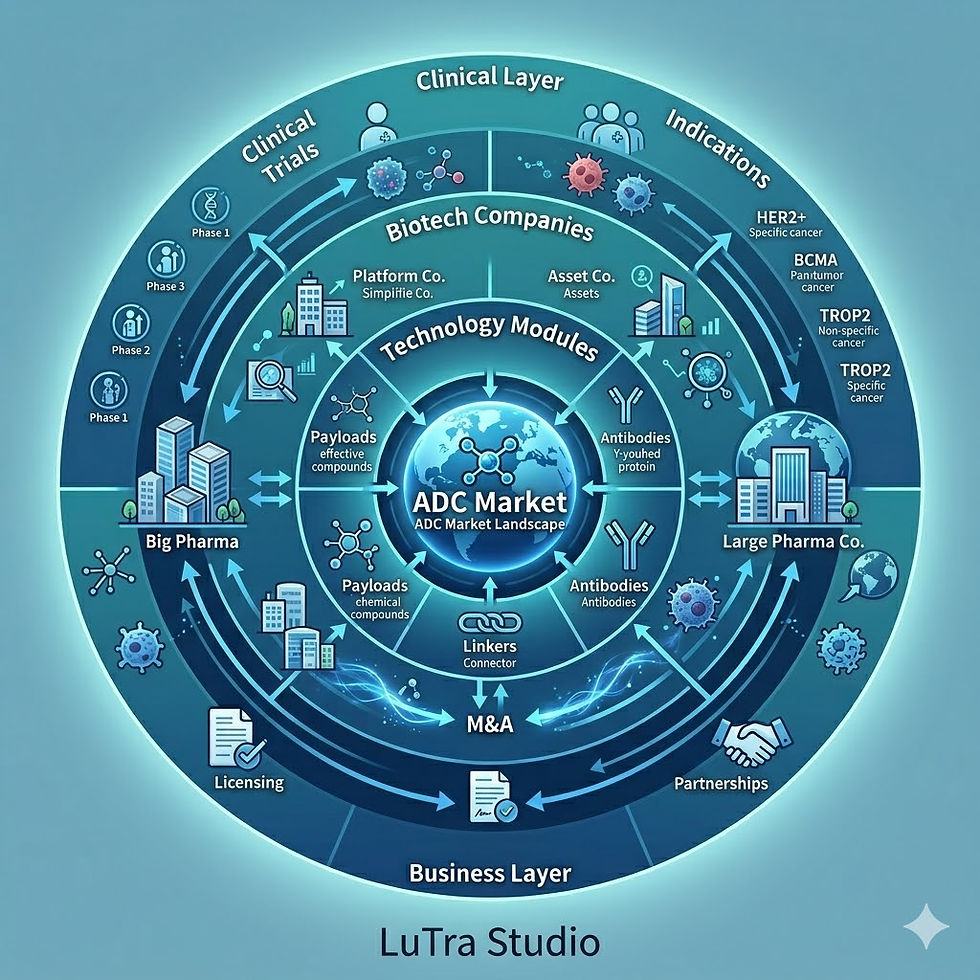
7. ADC Market: Competitive Dynamics of Antibody Drug Conjugates
The ADC market has become a critical component of antibody drug conjugate development.
Key Events
Pfizer acquisition of Seagen (2023)
AbbVie acquisition of ImmunoGen (announced 2023, completed 2024)
Multiple high-value ADC licensing deals
Competitive Logic
multiple companies targeting the same antigen
differentiation driven by payload, linker, and clinical strategy
👉 Antibody drug conjugates have entered a phase of:
fine differentiation competition
📌 Further reading:
8. Biotech Strategy: Who Will Win in the ADC Market?
Antibody drug conjugate companies can be broadly categorized into:
platform companies
asset-focused companies
hybrid models
👉 The key to success lies in:
strategic positioning
9. Future Directions of Antibody Drug Conjugates
Technology
multispecific ADCs
dual-payload ADCs
Clinical
combination therapies
biomarker-driven trials
Industry
platformization
accelerated business development
ecosystem formation
👉 Antibody drug conjugates are evolving into a fully integrated industry system
📚 ADC Series Overview
Series 1–3: Design
Series 4–5: Biology & Resistance
Series 6–7: Next-generation ADC
Series 8: Clinical Development
Series 9: Manufacturing (CMC)
Series 10: Market & Strategy
👉 This article serves as the complete entry point (Ultimate Guide)
🔥 Final Insight
The success of antibody drug conjugates has never been about a single breakthrough.
It is the result of system-level integration.
The future of competition will not be defined by:
better molecules alone
but by:
the ability to integrate design, clinical development, manufacturing, and market strategy
As the field of antibody drug conjugates continues to evolve:
👉 success will depend on holistic strategy, not isolated innovation
From Molecule to Strategy | LuTra Studio
In modern biotech:
scientific capability is the baseline
integration capability is the true competitive advantage
LuTra Studio supports:
ADC strategy development
pipeline evaluation
business development planning
integration of science and market positioning
👉 enabling antibody drug conjugates to successfully translate into real-world impact


Comments