

ADC Series (X) ADC Market & Strategy:How Antibody–Drug Conjugates Are Reshaping Biotech Competition

Executive Summary
Antibody–drug conjugates (ADCs) have rapidly evolved from an innovative therapeutic modality into one of the most strategically important areas in the biotech industry.
In recent years, the ADC market has undergone significant changes:
A surge in licensing deals and M&A activity
Increasing investment from large pharmaceutical companies in ADC pipelines
Growing focus among biotech startups on ADC platform technologies
These trends indicate that:
The ADC market has become one of the most active and competitive segments in oncology
This article explores:
Why the ADC market has become a major industry focus
Strategic differences between large pharma and biotech startups
Competitive dynamics of ADC pipelines
Market and deal trends from 2023 to 2026
Future directions of the ADC industry
1. Why Has the ADC Market Become a Hot Area?
1️⃣ Clinical Success Has Driven Market Confidence
Recent ADC success stories include:
Enhertu (trastuzumab deruxtecan)
Trodelvy
These demonstrate that ADCs offer:
strong anti-tumor efficacy
expandable indications
👉 These clinical successes have directly fueled investment and deal activity in the ADC market
2️⃣ Unmet Medical Need
Many cancers still:
lack effective therapies
develop resistance to existing treatments
👉 ADCs provide new therapeutic opportunities, expanding the overall market potential
3️⃣ Platform Expandability
ADCs can be optimized by modifying:
antibody
payload
linker
👉 enabling faster pipeline expansion
👉 Together, these factors create a powerful intersection of:
science × clinical success × capital, driving rapid growth of the ADC market
2. Big Pharma Strategy: The Core Driver of the ADC Market
Key Trend
Large pharmaceutical companies are not only developing ADCs internally, but increasingly acquiring innovation externally
Major Approaches
Licensing
upfront payments
milestone payments
royalties
M&A
acquiring biotech companies with ADC platforms or pipelines
Representative Examples
AstraZeneca × Daiichi Sankyo (Enhertu)
Pfizer acquisition of Seagen (2023)
AbbVie acquisition of ImmunoGen (2023)
👉 These examples highlight that the ADC market has become a central battlefield for business development (BD)
🔥 Emerging Trend (2025–2026)
ADC and broader biotech M&A are shifting structurally:
👉 Mid-sized acquisitions ($1B–$10B) are becoming dominant
These “bolt-on acquisitions”:
strengthen specific technologies or pipelines
reduce overall risk
improve integration efficiency
👉 This indicates that the ADC market is entering a phase of:
strategic allocation
Recent Examples (2026)
Biogen acquisition of Apellis (~$5.6B; not an ADC company, but reflects similar BD logic)
Continued acquisitions of innovative biotech companies by Lilly and Merck
👉 These moves suggest:
Large pharma is systematically externalizing innovation
3. ADC Company Types (Biotech Strategy Perspective)
1️⃣ Platform Companies
Focus on:
linker technologies
payload development
delivery systems
👉 With successful licensing or pipeline generation, these companies often have higher valuation potential
2️⃣ Asset Companies
Focus on:
one or a few ADC products
👉 Faster development timelines but higher concentration risk
3️⃣ Hybrid Model
Combine:
platform + pipeline
👉 Balance short-term value and long-term growth
👉 These strategies directly impact:
fundraising ability
BD opportunities
market positioning
4. Competitive Dynamics of ADC Pipelines
Multiple Players Target the Same Antigens
Examples:
HER2
Trop-2
Where Does Differentiation Come From?
👉 Not just the target, but:
payload design
linker technology
safety profile
clinical strategy
👉 The ADC market has entered a stage of:
fine differentiation competition
5. How Can Startups Enter the ADC Market?
Key Strategies
1️⃣ Focus on unmet needs
2️⃣ Build licensable platforms
3️⃣ Target niche indications
👉 The key to success:
strategic positioning
6. Key Risks in the ADC Market
Scientific Risks
target biology
resistance mechanisms
Clinical Risks
toxicity
trial failure
Manufacturing Risks
CMC complexity
scale-up challenges
Market Risks
overcrowded competition
insufficient differentiation
👉 The ADC market represents:
high reward × high risk
7. 2023–2026 ADC Deal Timeline (Key Industry Signals)
2023
Pfizer acquires Seagen
AbbVie acquires ImmunoGen
👉 The ADC market enters a consolidation phase
2024
Multiple ADC licensing deals exceeding $1B
Rapid pipeline expansion
2025
Continued strong dealmaking activity
Increasing focus on platform technologies
2026
Mid-sized M&A becomes dominant
Continued external innovation acquisition by pharma
The ADC market enters a mature competitive phase
👉 Key signal:
ADCs have transitioned from a “technology opportunity” to a “capital-driven competitive battlefield”
8. Future Directions of the ADC Market
Technology Trends
multispecific ADCs
dual-payload ADCs
next-generation linkers
Clinical Trends
combination therapies
biomarker-driven trials
Industry Trends
platformization
accelerated BD activity
ecosystem formation
👉 The ADC market is evolving into a:
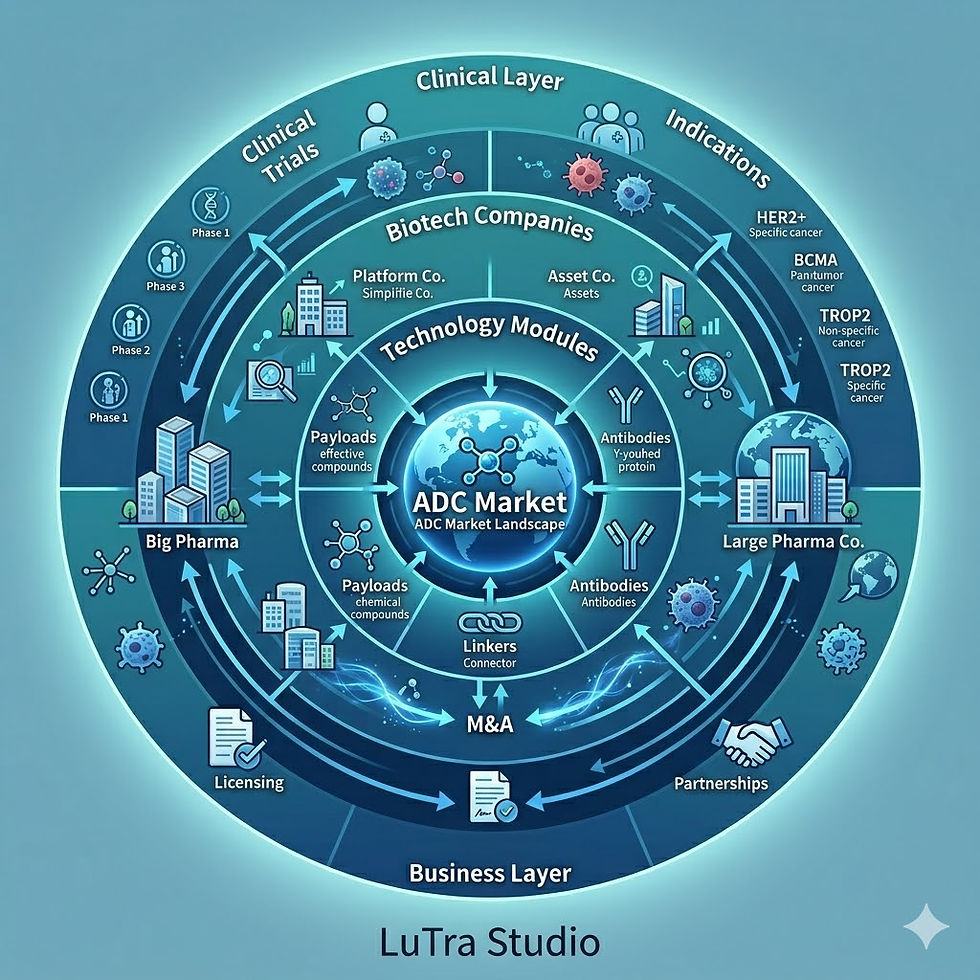
multi-layered ecosystem spanning technology, clinical development, and business strategy
🔥 Key Insight
A clear industry signal is:
ADCs are no longer just a drug modality, but a central arena where capital and technology compete simultaneously
As the ADC market continues to evolve:
👉 long-term success will depend on overall strategy, not just individual technological advantages
From Technology to Strategy | LuTra Studio Consulting
Successful ADC development requires integration across:
science
clinical execution
manufacturing
business strategy
At LuTra Studio, we support teams by:
designing ADC strategies
evaluating pipelines
planning BD pathways
integrating technology with market positioning
so that companies do not just develop products, but:
👉 build sustainable competitive advantages


Comments