

PEG-free LNP: Can pDLS Replace PEG in Next-Generation mRNA Delivery?


Introduction: The Next Bottleneck in mRNA Therapeutics May Not Be RNA—It May Be the LNP
Since the successful launch of COVID-19 mRNA vaccines, mRNA technology has rapidly expanded beyond infectious diseases into areas such as cancer immunotherapy, gene editing, protein replacement therapy, and regenerative medicine.
Many scientists believe the next decade will be the golden age of RNA therapeutics.
However, anyone who has worked in mRNA drug development quickly realizes a fundamental truth:
The biggest challenge is often not the RNA itself—it is how to deliver RNA safely and efficiently into target cells.
mRNA is a large, negatively charged nucleic acid molecule. It is highly susceptible to nuclease degradation and cannot easily cross cell membranes on its own. As a result, lipid nanoparticles (LNPs) have become the most successful delivery platform for RNA therapeutics to date.
Yet even the most mature LNP technologies are beginning to face new challenges.
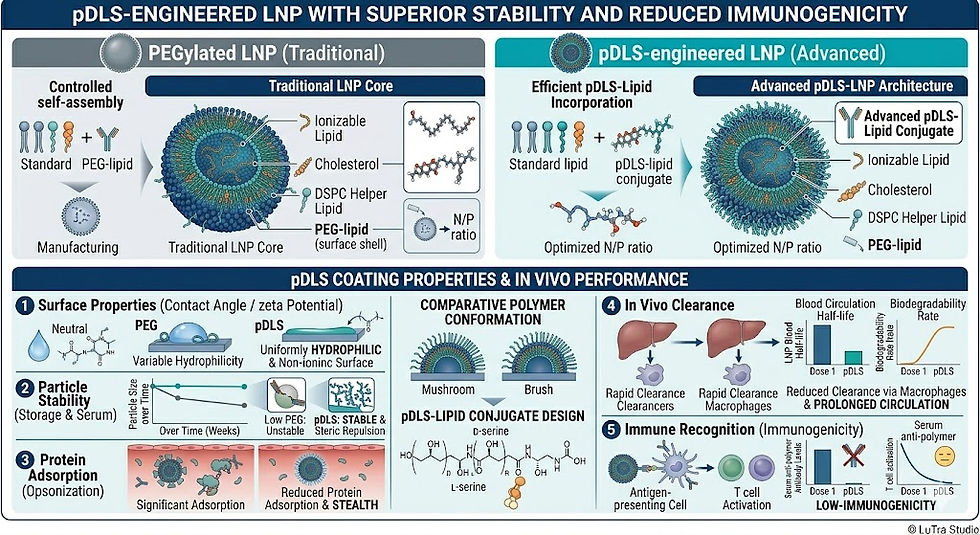
Recent studies have shown that PEGylated LNPs may induce anti-PEG antibodies, potentially impacting the safety and efficacy of repeat dosing.
This is the problem addressed by a recent Nature Communications paper titled:
“Polypeptide-engineered lipid nanoparticles for mRNA delivery with limited immunogenicity.”
In this study, the authors developed a new PEG-free LNP platform by replacing conventional PEG-lipids with poly(D,L-serine) (pDLS), aiming to maintain nanoparticle stability and delivery efficiency while reducing immunogenicity.
Why Are PEG-free LNPs Becoming Important for mRNA Delivery?
Most clinically relevant LNP formulations consist of four key components:
Ionizable lipid
Cholesterol
Helper lipid (DSPC)
PEG-lipid
PEG-lipids play several important roles:
Controlling particle size
Enhancing nanoparticle stability
Reducing aggregation
Minimizing protein adsorption
Extending circulation time
Both Pfizer/BioNTech’s BNT162b2 and Moderna’s mRNA-1273 vaccines utilize PEG-lipids.
For years, PEG has been considered an essential component of LNP formulations.
However, as RNA therapeutics move toward chronic and repeat-dose applications, the limitations of PEG are becoming increasingly apparent.

Anti-PEG Antibodies: A Growing Concern in the Industry
PEG is not exclusive to pharmaceutical products.
It is commonly found in:
Cosmetics
Personal care products
Food additives
Everyday medications
As a result, many people have already been exposed to PEG long before receiving an mRNA vaccine.
Studies have reported that 98–99% of unvaccinated individuals have detectable anti-PEG antibodies, with approximately 3–4% carrying relatively high antibody levels.
This may create two important challenges.
Accelerated Blood Clearance (ABC)
Upon repeat administration, LNPs may be cleared more rapidly from circulation, reducing therapeutic efficacy.
Hypersensitivity Reactions
In some individuals, anti-PEG immune responses may contribute to:
Allergic reactions
Complement activation
Severe hypersensitivity responses
Although the clinical significance is still being investigated, these concerns become increasingly important for therapies requiring long-term repeat dosing.

The Core Concept of This Study: Replacing PEG with Polyserine
To address these challenges, the researchers designed a series of amphiphilic poly(D,L-serine) lipids.
pDLS possesses several attractive characteristics:
Hydrophilic
Nonionic
Biodegradable
Amino acid-derived
Unlike PEG, pDLS is a polypeptide-based material.
In theory, this makes it easier for biological systems to metabolize and eliminate.
The team synthesized pDLS lipids with different polymer lengths and lipid structures using ring-opening polymerization and incorporated them into LNP formulations containing:
ALC-0315
DSPC
Cholesterol
mRNA
The result was a novel PEG-free LNP platform.
Experiment 1: Can PEG-free LNPs Maintain Favorable Physical Properties?
Any new nanoparticle system must first demonstrate acceptable physical characteristics.
The pDLS-LNPs showed:
Particle size: approximately 87–100 nm
PDI: less than 0.14
Near-neutral zeta potential
Encapsulation efficiency: approximately 75–90%
Overall, these properties were comparable to clinically used PEGylated LNP formulations.
This suggests that PEG is not the only material capable of providing nanoparticle stability.
Experiment 2: Does PEG-free LNP Improve mRNA Delivery Efficiency?
The authors next evaluated transfection performance in:
DC2.4 dendritic cells
HEK293T cells
The results were striking.
Optimized pDLS-LNP formulations achieved:
Approximately 10-fold higher transfection in DC2.4 cells
Approximately 6.5-fold higher transfection in HEK293T cells
These findings indicate that pDLS may offer more than just a replacement for PEG—it may actually enhance delivery performance.
Why Did pDLS-LNP Perform Better?
The researchers identified two key mechanisms.
Increased Cellular Uptake
Flow cytometry analysis revealed approximately 4.6-fold higher cellular uptake for pDLS-LNPs.
The authors hypothesized that the polypeptide surface interacts more favorably with cells than PEG, promoting nanoparticle internalization.
Enhanced Endosomal Escape
The team investigated endosomal escape using:
Hemolysis assays
Confocal microscopy
Colocalization analysis
Results showed that pDLS-LNPs exhibited stronger membrane-disruptive activity under acidic conditions, enabling more mRNA to escape endosomes and reach the cytoplasm for translation.
This likely contributed significantly to the enhanced transfection efficiency.

Experiment 3: How Did PEG-free LNP Perform In Vivo?
To evaluate in vivo delivery, the researchers encapsulated luciferase mRNA and administered the formulations via subcutaneous injection.
Both pDLS-LNP and ALC-LNP generated robust luciferase expression.
Biodistribution studies revealed accumulation primarily in:
Liver
Spleen
Lymph nodes
These patterns were generally consistent with conventional LNP systems.
Interestingly, certain low-degree-polymerization pDLS formulations demonstrated reduced liver accumulation, suggesting a potential opportunity to minimize liver toxicity in future applications.
Experiment 4: Performance as a SARS-CoV-2 mRNA Vaccine
The authors further evaluated pDLS-LNPs as a vaccine delivery platform using SARS-CoV-2 spike mRNA.
A prime-boost vaccination strategy was employed to assess:
Humoral immunity
Cellular immunity
Memory B-cell responses
The results were encouraging.
Strong Antibody Responses
High levels of anti-spike IgG were generated and maintained for more than 11 weeks.
Potent Neutralizing Activity
Neutralizing antibody responses were comparable to those achieved with conventional ALC-LNP formulations.
Enhanced T-cell Responses
pDLS2-LNP significantly increased IFN-γ secretion, indicating stronger cellular immunity.
Increased Memory B Cells
Certain pDLS formulations generated two- to three-fold higher levels of RBD-specific memory B cells.
The Most Important Finding: Minimal Anti-pDLS Antibody Formation
Arguably the most significant result of the study was the immunogenicity profile.
While PEG-LNP formulations induced detectable anti-PEG IgM responses following repeat administration, pDLS-LNPs generated little to no anti-pDLS IgM.
This finding could have major implications for:
Cancer vaccines
Protein replacement therapies
Gene editing
In vivo CAR-T therapies
All of these applications may require repeated administration over time.
Long-Term Storage Stability Is Another Advantage
Beyond delivery efficiency and immunogenicity, the authors also evaluated storage stability.
After six months at -80°C, pDLS-LNP formulations maintained:
Particle size
Encapsulation efficiency
Zeta potential
In vivo expression performance
These results suggest that pDLS-LNPs are not merely an academic concept but may possess genuine translational potential.

My Perspective: What Makes This Study Important?
At first glance, this may appear to be just another LNP formulation paper.
However, I believe it reflects a much broader industry trend.
Over the past decade, the primary challenge has been:
Can we deliver RNA into cells?
The next decade may focus on different questions:
Can we safely administer RNA therapeutics repeatedly?
Can we reduce immunogenicity?
Can we avoid anti-PEG antibody responses?
Can we support chronic disease treatment?
In other words, competition in RNA delivery is gradually shifting from delivery efficiency to long-term usability.
This is exactly why PEG-free LNP platforms are attracting increasing attention.
From PEG-free LNP to Next-Generation RNA Therapeutics: Challenges Remain
Despite the promising results, several hurdles remain before clinical translation.
Key areas requiring further validation include:
Repeat-dosing studies
Non-human primate studies
GMP manufacturing
Process scale-up
Regulatory strategy
CMC development
Intellectual property planning
For many RNA therapeutic companies, delivery platform development is no longer purely a scientific challenge—it is an integrated effort spanning science, manufacturing, regulatory affairs, and business strategy.
The LuTra Studio Perspective
At LuTra Studio, we closely follow emerging technologies that bridge scientific innovation and commercial translation.
Our focus areas include:
mRNA therapeutics
Gene editing
Lipid nanoparticles
Drug delivery systems
Biotechnology strategy
We help organizations evaluate:
Emerging technology trends
U.S. biotech market strategy
Platform positioning
Commercialization opportunities
Competitive landscape analysis
Scientific communication and branding
Because transformative technologies are rarely defined by a single publication.
Their true value lies in becoming scalable, manufacturable, and commercially viable products.
👉 Learn more about LuTra Studio Consulting:
Conclusion: PEG-free LNP May Represent an Important Direction for Future RNA Therapeutics
PEG has played a critical role in making LNPs the most successful nucleic acid delivery platform of the past decade.
However, as RNA therapeutics expand into chronic disease treatment, oncology, and gene editing, the limitations of PEG are becoming increasingly evident.
This Nature Communications study demonstrates that pDLS-LNPs may provide a promising alternative by combining:
Strong delivery performance
Reduced immunogenicity
Long-term stability
Although significant work remains before clinical implementation, PEG-free LNP technology could become an important component of the next generation of RNA therapeutics.
References
Zeng JY, Chen Y, Wang X, et al. Polypeptide-engineered lipid nanoparticles for mRNA delivery with limited immunogenicity. Nature Communications. 2026.


Comments