

iPSC Cell Therapy: Autologous vs. Allogeneic — The Future of Off-the-Shelf Cell Therapy


Executive Summary
Key Takeaways
Induced pluripotent stem cells (iPSCs) have evolved from a stem cell technology into a scalable manufacturing platform for next-generation cell therapies.
Autologous and allogeneic cell therapies each offer distinct advantages and limitations, and both are expected to play important roles depending on disease indications.
The greatest advantage of iPSC technology lies in its ability to establish Master Cell Banks (MCBs), enabling standardized, large-scale manufacturing of therapeutic cells.
Human leukocyte antigen (HLA) matching, gene editing, and immune engineering are driving the development of off-the-shelf allogeneic iPSC-derived therapies.
As GMP manufacturing, automation, artificial intelligence, and digital biomanufacturing continue to mature, iPSC platforms are becoming a cornerstone of regenerative medicine and advanced therapeutics.
The future of cell therapy will depend not only on advances in stem cell biology but also on the integration of manufacturing science, quality systems, automation, and regulatory strategy.
Introduction: The Real Value of iPSCs Is Not Reprogramming—It Is Building Cell Therapies
In the previous article, we explored the fundamentals of induced pluripotent stem cells (iPSCs), including cellular reprogramming, pluripotency, disease modeling, and regenerative medicine.
However, when you move from academia into the biotechnology industry, the questions change dramatically.
Researchers often ask:
“How can we generate an iPSC line?”
Biotechnology companies ask:
“How can we turn an iPSC into a commercially viable therapy?”
Although these questions appear similar, they represent two fundamentally different perspectives.
In an academic laboratory, successfully generating a high-quality iPSC line may be sufficient to answer an important biological question or support a scientific publication.
In industry, however, generating an iPSC line is only the starting point.
The real challenges include:
Can the manufacturing process be scaled?
Can product quality remain consistent across production batches?
Can manufacturing costs be reduced without compromising quality?
Can the process comply with GMP and regulatory expectations?
Can patients receive treatment when they actually need it?
These questions define the next stage of regenerative medicine.
Today, the success of a cell therapy is determined not only by biology but also by manufacturing, quality, and commercialization.
From Personalized Medicine to Off-the-Shelf Cell Therapy
The first generation of modern cell therapies has been dominated by autologous approaches.
In an autologous therapy, cells are collected from an individual patient, genetically modified or expanded outside the body, and then infused back into that same patient.
The most successful examples include commercially approved CAR-T cell therapies such as:
Kymriah® (Novartis)
Yescarta® (Gilead/Kite)
Breyanzi® (Bristol Myers Squibb)
Carvykti® (Johnson & Johnson / Legend Biotech)
These therapies have demonstrated remarkable clinical efficacy, particularly in hematologic malignancies.
However, they have also exposed several limitations of personalized manufacturing.
Each patient requires an independent manufacturing campaign, resulting in:
Complex production logistics
Long manufacturing timelines
High production costs
Significant operator involvement
Limited scalability
For patients with rapidly progressing disease, waiting several weeks for manufacturing may directly affect treatment outcomes.
These challenges have prompted the field to pursue a different paradigm:
What if therapeutic cells could be manufactured in advance and stored until they are needed?
This concept has become known as off-the-shelf cell therapy.
Why iPSCs Are Becoming the Foundation of Off-the-Shelf Cell Therapy
Unlike most adult somatic cells, induced pluripotent stem cells possess virtually unlimited self-renewal capacity while retaining the ability to differentiate into a wide variety of specialized cell types.
This unique combination allows researchers to establish a well-characterized iPSC line, expand it extensively, create a Master Cell Bank (MCB), and use that bank as the starting material for manufacturing multiple therapeutic products.
Rather than producing a new product for every individual patient, manufacturers can generate standardized batches capable of treating many patients.
From a manufacturing perspective, this model closely resembles the production of monoclonal antibodies or recombinant biologics, where a single, highly characterized cell bank supports long-term commercial manufacturing.
For this reason, iPSCs are increasingly viewed not simply as stem cells, but as a renewable manufacturing platform for regenerative medicine.
This shift explains why many biotechnology companies are investing heavily in iPSC technologies.
Their goal is not merely to develop one therapy, but to establish a scalable platform capable of supporting an entire pipeline of therapeutic products.
Biology Is the Beginning—Manufacturing Is the Real Challenge
Fifteen years ago, the central question in the iPSC field was straightforward:
Can differentiated somatic cells be successfully reprogrammed?
Today, that biological question has largely been answered.
The greatest challenge has shifted toward manufacturing.
Developing a clinically meaningful iPSC-derived therapy requires much more than generating pluripotent cells.
Companies must establish robust processes capable of producing billions of therapeutic cells while maintaining consistent identity, purity, potency, genomic stability, and regulatory compliance.
As a result, modern iPSC development increasingly depends on expertise in:
Manufacturing Science
Process Development
Chemistry, Manufacturing, and Controls (CMC)
Automation
Quality Systems
Regulatory Science
These disciplines are now just as important as stem cell biology itself.
What This Article Will Cover
In this article, we will explore how iPSCs are becoming the foundation of next-generation cell therapies by addressing several key questions:
What are the differences between autologous and allogeneic cell therapies?
Why are iPSCs particularly well suited for off-the-shelf manufacturing?
How does HLA matching improve the feasibility of allogeneic cell therapies?
Can gene editing create universal donor cell lines?
Which iPSC-derived therapies have entered clinical development?
Why will manufacturing—not biology alone—determine the future success of regenerative medicine?
If the previous article answered the question:
What are induced pluripotent stem cells?
This article focuses on the next question:
How do induced pluripotent stem cells become real medicines?
Autologous vs. Allogeneic Cell Therapy: Which Strategy Will Shape the Future?
One of the most fundamental questions in modern cell therapy is deceptively simple:
Should therapeutic cells come from the patient or from a healthy donor?
Although both approaches aim to restore or replace diseased tissues, they represent fundamentally different manufacturing strategies, supply chains, and commercialization models.
Today, virtually all cell therapies fall into one of two categories:
Autologous Cell Therapy
Allogeneic Cell Therapy
Understanding the differences between these approaches is essential for appreciating why iPSC technology has become such a powerful platform for regenerative medicine.
Autologous Cell Therapy
Autologous cell therapy uses a patient’s own cells as the starting material.
A simplified manufacturing workflow is shown below:
Patient
↓
Cell Collection
↓
Cell Isolation
↓
Genetic Engineering and/or Cell Expansion
↓
Quality Control
↓
Cryopreservation
↓
Patient Infusion
Because the therapeutic cells originate from the same patient, autologous therapies generally exhibit excellent immunological compatibility and carry minimal risk of immune rejection.
The best-known examples include commercially approved CAR-T cell therapies such as:
Kymriah® (Novartis)
Yescarta® (Gilead/Kite)
Breyanzi® (Bristol Myers Squibb)
Carvykti® (Johnson & Johnson / Legend Biotech)
These therapies have dramatically changed the treatment landscape for hematologic malignancies and demonstrated that living cell products can achieve durable clinical responses.
Advantages of Autologous Cell Therapy
Excellent Immunological Compatibility
Since the cells are collected from the patient and returned to that same individual, autologous therapies largely avoid complications associated with donor-recipient incompatibility.
In most cases, there is little concern regarding:
HLA mismatch
Host-versus-graft (HvG) rejection
Graft-versus-host disease (GVHD)
This immunological advantage has been a major contributor to the clinical success of autologous CAR-T therapies.
Personalized Cellular Products
Every manufactured product is uniquely tailored to an individual patient.
Unlike allogeneic approaches, autologous therapies do not require:
Master Cell Banks (MCBs)
HLA matching
Universal donor cell lines
From a biological perspective, this greatly simplifies immune compatibility.
Well-Established Regulatory Experience
Following more than a decade of clinical development, regulatory agencies such as the U.S. Food and Drug Administration (FDA) have accumulated substantial experience evaluating autologous cell therapies.
Today, regulatory expectations for areas such as:
Starting material qualification
Chain of Identity (COI)
Chain of Custody (COC)
Manufacturing controls
are considerably more mature than they were during the early years of CAR-T development.
The Manufacturing Limitations of Autologous Therapies
Despite their clinical success, autologous therapies present several significant manufacturing challenges.
One Patient Equals One Manufacturing Batch
Perhaps the greatest limitation is that every patient requires an independent manufacturing campaign.
For conventional biologics, a single production batch may supply thousands—or even millions—of doses.
Autologous therapies operate very differently.
Each patient’s cells represent an individual manufacturing lot.
Every lot requires:
Independent manufacturing
Independent quality control
Independent release testing
This manufacturing paradigm is commonly described as scale-out manufacturing, rather than traditional scale-up manufacturing.
Instead of increasing the size of a production batch, manufacturers increase the number of parallel manufacturing runs.
Long Manufacturing Timelines
A typical autologous CAR-T manufacturing workflow includes:
Leukapheresis
Shipment to a GMP manufacturing facility
Genetic modification
Cell expansion
Quality control testing
Cryopreservation
Shipment back to the treatment center
Depending on the product and manufacturing facility, the vein-to-vein time typically ranges from approximately two to five weeks.
For patients with rapidly progressing diseases, manufacturing delays may directly influence clinical outcomes.
High Manufacturing Costs
Because every manufacturing campaign is patient-specific, virtually every production step must be repeated independently.
These include:
GMP manufacturing
Skilled personnel
Quality control testing
Logistics
Cold-chain transportation
Consequently, many commercially available CAR-T products are priced at more than US$400,000 per treatment, reflecting not only the complexity of the biology but also the challenges of individualized manufacturing.
Variable Starting Material
Another frequently overlooked limitation is variability in the patient’s own cells.
Many patients receiving CAR-T therapy have undergone multiple rounds of chemotherapy before leukapheresis.
As a result, harvested T cells may exhibit:
Reduced proliferative capacity
Increased cellular exhaustion
Lower overall cell quality
Even when manufacturing processes are identical, variability in the starting material can significantly affect product consistency and clinical performance.
Allogeneic Cell Therapy
Allogeneic cell therapy follows a fundamentally different strategy.
Instead of using cells collected from each individual patient, therapeutic cells are generated from a healthy donor and manufactured as standardized products that can be administered to multiple patients.
A simplified workflow is shown below:
Healthy Donor
↓
Master Cell Bank
↓
Working Cell Bank
↓
Large-Scale Manufacturing
↓
Cryopreservation
↓
Hospital Inventory
↓
Multiple Patients
Unlike autologous therapies, allogeneic products can be manufactured before patients require treatment.
For this reason, they are commonly referred to as off-the-shelf cell therapies.
Advantages of Allogeneic Cell Therapy
Scalable Manufacturing
Perhaps the greatest advantage of allogeneic therapies is their manufacturing scalability.
A single well-characterized cell line can be expanded to establish:
Master Cell Banks (MCBs)
Working Cell Banks (WCBs)
Large-scale production campaigns
allowing one manufacturing process to support treatment for many patients.
This production model closely resembles that used for monoclonal antibodies and other biologic medicines.
Improved Batch Consistency
Because all products originate from the same qualified cell bank, manufacturers benefit from:
Standardized starting material
Consistent genetic background
Uniform quality control criteria
These factors significantly improve batch-to-batch reproducibility, an essential requirement for commercial manufacturing.
Immediate Product Availability
Unlike autologous therapies, allogeneic products can be manufactured in advance, cryopreserved, and distributed to treatment centers before they are needed.
This greatly reduces treatment delays and may be particularly valuable for diseases requiring rapid intervention.
The Greatest Challenge: Immune Rejection
The principal obstacle to allogeneic cell therapy is immune compatibility.
Because donor-derived cells are recognized as foreign, recipients may develop immune responses including:
Host-versus-graft (HvG) rejection
Cytotoxic T-cell activation
Natural killer (NK) cell-mediated cytotoxicity
Consequently, successful allogeneic therapies often require combinations of:
HLA matching
Immunosuppressive therapy
Gene editing
Immune engineering
to improve long-term engraftment and persistence.
Why iPSCs Are Particularly Well Suited for Allogeneic Cell Therapy
Most adult somatic cells possess limited proliferative capacity, making them difficult to expand indefinitely.
Induced pluripotent stem cells, however, combine virtually unlimited self-renewal with broad differentiation potential.
These characteristics enable manufacturers to:
Establish large Master Cell Banks
Produce standardized therapeutic products
Differentiate into multiple clinically relevant cell types
Apply gene editing before manufacturing begins
As a result, iPSCs have become one of the most promising platforms for developing scalable allogeneic cell therapies.
Companies such as:
Century Therapeutics
Fate Therapeutics
Kyoto University / CiRA
Heartseed
have all adopted iPSC-based strategies to build next-generation therapeutic platforms.
Industry Perspective: Scale-Out Versus Scale-Up Manufacturing
One of the most important distinctions in cell therapy manufacturing is the difference between scale-out and scale-up.
Autologous therapies rely on scale-out manufacturing, where each patient requires an independent production run.
In contrast, allogeneic therapies aim to achieve scale-up manufacturing, using standardized cell banks and robust manufacturing processes to produce large quantities of therapeutic cells for many patients.
This distinction extends far beyond manufacturing.
It influences:
Cost of goods (COGs)
Supply chain logistics
Regulatory strategy
Facility design
Commercial scalability
In my view, both manufacturing models will continue to coexist.
Autologous therapies will remain important for highly personalized treatments, while allogeneic approaches—particularly those built on iPSC platforms—are likely to drive the next generation of scalable regenerative medicine.

HLA Matching and Universal Donors: Can One iPSC Line Treat Many Patients?
If iPSCs represent the foundation of allogeneic cell therapy, the next question becomes inevitable:
How can donor-derived cells avoid immune rejection after transplantation?
This challenge sits at the center of every allogeneic cell therapy program.
Unlike autologous therapies, which use a patient’s own cells, allogeneic products introduce genetically distinct cells into another individual. Although this strategy dramatically improves manufacturing efficiency and scalability, it also exposes transplanted cells to immune surveillance by the recipient.
Consequently, one of the primary goals of modern regenerative medicine is to maximize donor compatibility while minimizing immune-mediated rejection.
Two major strategies have emerged:
HLA matching
Immune engineering through gene editing
Rather than competing with one another, these approaches are increasingly viewed as complementary technologies that together enable the development of scalable off-the-shelf cell therapies.
What Is HLA?
Human Leukocyte Antigen (HLA) molecules are cell-surface proteins encoded within the major histocompatibility complex (MHC) on chromosome 6.
Their primary function is to present antigenic peptides to T cells, allowing the immune system to distinguish between “self” and “non-self.”
The most clinically relevant loci include:
Class I
HLA-A
HLA-B
HLA-C
Class II
HLA-DR
HLA-DQ
HLA-DP
Because HLA genes are highly polymorphic, every individual possesses a unique HLA profile.
This remarkable genetic diversity provides broad protection against infectious diseases at the population level, but it also presents a major obstacle for transplantation.
When donor cells express HLA molecules that differ from those of the recipient, the immune system may recognize them as foreign, leading to:
Host-versus-graft (HvG) rejection
Cytotoxic T-cell activation
Antibody-mediated immune responses
Reduced graft survival
For decades, HLA matching has therefore been a cornerstone of solid organ transplantation and hematopoietic stem cell transplantation.
The same immunological principles also apply to allogeneic iPSC-derived cell therapies.
The CiRA iPSC Stock Project
Rather than generating a personalized iPSC line for every patient, researchers at Kyoto University’s Center for iPS Cell Research and Application (CiRA) proposed an entirely different strategy.
Instead of manufacturing a unique product for each individual, why not establish a bank of clinical-grade iPSC lines derived from carefully selected donors with favorable HLA haplotypes?
This concept became known as the iPSC Stock Project.
The project recruits donors who are HLA-homozygous, meaning they carry identical HLA haplotypes on both homologous chromosomes.
These donor-derived iPSC lines are extensively characterized, expanded under GMP-compatible conditions, and cryopreserved to establish renewable Master Cell Banks.
When a patient requires treatment, clinicians can select the HLA-matched cell line that offers the closest immunological compatibility.
Compared with generating patient-specific iPSCs, this strategy offers several important advantages:
Shorter manufacturing timelines
Reduced production costs
Improved product standardization
Simplified quality control
Greater manufacturing scalability
Rather than producing thousands of individualized cell lines, a relatively small collection of carefully selected HLA-homozygous iPSC lines can potentially provide suitable matches for a substantial proportion of the population.
The exact level of population coverage varies by ethnicity and HLA distribution, but the overall principle remains the same:
maximize clinical accessibility while minimizing manufacturing complexity.
Why HLA-Homozygous Donors Matter
Most individuals inherit different HLA haplotypes from each parent and are therefore HLA-heterozygous.
By contrast, HLA-homozygous donors possess identical HLA haplotypes on both chromosomes.
This distinction has important practical implications.
Because both chromosomes carry the same haplotype, one donor-derived iPSC line can potentially match many recipients who share that haplotype.
In other words, a single well-characterized iPSC line may serve multiple unrelated patients.
From a manufacturing perspective, this dramatically improves scalability.
Instead of establishing separate manufacturing platforms for individual patients, developers can repeatedly manufacture therapeutic products from the same qualified Master Cell Bank.
This strategy transforms iPSCs from personalized research tools into standardized manufacturing platforms.
Does HLA Matching Eliminate Immune Rejection?
The answer is no.
This is one of the most common misconceptions surrounding allogeneic cell therapy.
Although HLA matching substantially reduces immune responses, it does not eliminate them completely.
Several additional mechanisms contribute to graft rejection, including:
Minor histocompatibility antigens
Natural killer (NK) cell activation
Innate immune responses
Local inflammatory microenvironments
Complement activation
As a result, even HLA-matched cell therapies may require:
Temporary immunosuppression
Local immune modulation
Genetic engineering
Optimized transplantation protocols
HLA matching should therefore be viewed as a strategy to reduce immunological risk rather than a complete solution.
Technical Insight: Cell Therapy Is Not Organ Transplantation
Although both organ transplantation and iPSC-derived cell therapy rely on HLA compatibility, their immunological environments differ substantially.
A transplanted kidney or liver contains numerous interacting cell types, resident immune cells, and vascular structures, all of which continuously express donor antigens.
In contrast, iPSC-derived therapies often transplant a relatively homogeneous population of specialized cells, such as:
Dopaminergic neurons
Cardiomyocytes
Retinal pigment epithelial (RPE) cells
Pancreatic β cells
Moreover, different anatomical sites exhibit distinct immune characteristics.
For example:
The eye is considered relatively immune privileged, making retinal therapies less susceptible to immune-mediated rejection.
The central nervous system exhibits specialized immune regulation but is not completely immune privileged, particularly under inflammatory conditions.
Cardiac tissues remain highly vascularized and are continuously exposed to circulating immune cells.
Consequently, immune management strategies must be tailored to the biological context of each therapeutic indication.
Gene Editing: Building Universal Donor Cell Lines
If HLA matching cannot completely eliminate immune rejection, another logical approach is to modify the cells themselves.
Advances in CRISPR-Cas9, base editing, and prime editing have made it increasingly feasible to engineer iPSC lines with reduced immunogenicity.
These engineered cells are commonly referred to as universal donor cells.
Rather than relying solely on donor-recipient compatibility, universal donor strategies aim to reduce immune recognition through targeted genetic modifications.
Current approaches include:
B2M knockout, which reduces HLA class I expression and decreases CD8⁺ T-cell recognition.
CIITA knockout, which suppresses HLA class II expression and limits antigen presentation to CD4⁺ T cells.
HLA-E or HLA-G overexpression, which inhibits NK cell activation despite reduced classical HLA expression.
CD47 overexpression, providing a “don’t eat me” signal that decreases macrophage-mediated phagocytosis.
Importantly, these modifications are rarely implemented in isolation.
For example, complete removal of HLA class I molecules may successfully evade cytotoxic T cells but simultaneously trigger NK-cell-mediated killing through the “missing-self” mechanism.
Consequently, many next-generation universal donor strategies combine multiple genetic modifications to balance immune evasion with long-term graft survival.
Rather than representing a single gene-editing event, universal donor platforms increasingly rely on sophisticated immune engineering strategies.

Clinical Translation: Where Are iPSC-Derived Cell Therapies Today?
Since the discovery of induced pluripotent stem cells nearly two decades ago, the field has progressed from proof-of-concept experiments to early-stage clinical translation.
Today, multiple iPSC-derived products have entered clinical trials, demonstrating that pluripotent stem cells can be manufactured, differentiated, and delivered safely to patients.
However, not every disease is equally suitable for cell replacement therapy.
The clinical programs that have advanced the furthest tend to share several common characteristics:
The target cell type is well defined.
Disease pathology is driven by the loss of a specific cell population.
Transplanted cells can integrate into host tissues or provide measurable biological functions.
Clinical outcomes can be objectively evaluated.
As a result, the leading indications for iPSC-derived therapies currently include:
Neurodegenerative diseases
Cardiovascular diseases
Retinal disorders
Cancer immunotherapy
These programs are shaping the future of regenerative medicine while simultaneously validating the broader iPSC manufacturing platform.
Parkinson’s Disease: The Most Advanced iPSC Cell Therapy Program
Among all clinical applications, Parkinson’s disease remains one of the strongest demonstrations of iPSC-based regenerative medicine.
The disease is characterized primarily by the progressive degeneration of dopaminergic neurons within the substantia nigra, resulting in dopamine deficiency and impaired motor function.
Unlike many complex disorders involving multiple cell types, Parkinson’s disease presents an attractive target for cell replacement because the affected neuronal population is relatively well defined.
The therapeutic concept is therefore straightforward:
Replace the lost dopaminergic neurons.
Kyoto University / CiRA
The most influential clinical program has been led by Kyoto University’s Center for iPS Cell Research and Application (CiRA).
Researchers generated clinical-grade allogeneic iPSC-derived dopaminergic progenitor cells and transplanted them into the putamen of patients with Parkinson’s disease.
Early Phase I/II studies demonstrated several encouraging findings:
Acceptable safety profile
No evidence of tumor formation
Survival of transplanted cells confirmed by PET imaging
Preliminary improvements in motor function in selected patients
Although larger controlled studies remain necessary, these results represent an important milestone for regenerative medicine by demonstrating that iPSC-derived neural cells can be safely transplanted into human patients.
BlueRock Therapeutics
BlueRock Therapeutics has also developed one of the most advanced neuronal replacement programs.
However, an important distinction should be emphasized.
BlueRock’s lead candidate, bemdaneprocel (formerly BRT-DA01), is derived from human embryonic stem cells (hESCs) rather than induced pluripotent stem cells.
Both programs pursue the same biological objective—replacing dopaminergic neurons—but they originate from different pluripotent stem cell platforms.
This distinction is frequently overlooked and is important when comparing clinical pipelines across companies.
Aspen Neuroscience
Aspen Neuroscience is pursuing an entirely different strategy based on autologous iPSC technology.
Instead of using donor-derived cells, the company generates patient-specific iPSCs from skin biopsies, differentiates them into dopaminergic neurons, and returns them to the same patient.
Potential advantages include:
Excellent immunological compatibility
Minimal risk of HLA mismatch
Reduced dependence on long-term immunosuppression
However, these benefits come with important manufacturing challenges.
Each patient requires an independent manufacturing campaign, making production more expensive, time-consuming, and less scalable than allogeneic approaches.
Heart Failure: Can We Regenerate the Human Heart?
Cardiovascular disease represents another major frontier for regenerative medicine.
Unlike certain epithelial tissues, adult human cardiomyocytes possess very limited regenerative capacity.
Once large numbers of cardiomyocytes are lost following myocardial infarction or progressive heart failure, spontaneous recovery is minimal.
For decades, regenerative medicine has sought to overcome this limitation through cell replacement.
Heartseed
One of the leading companies in this field is Heartseed, a Japanese biotechnology company developing allogeneic iPSC-derived cardiomyocyte spheroids.
Rather than injecting isolated single cells, Heartseed manufactures three-dimensional spheroids composed of cardiomyocytes.
Compared with dissociated cells, spheroids may improve:
Cell retention
Cell survival
Engraftment efficiency
Functional integration
In 2026, Heartseed initiated patient dosing in its domestic Phase I/II EMERALD study, representing one of the world’s most advanced clinical programs evaluating iPSC-derived cardiomyocytes for severe heart failure.
Cuorips
Another Japanese company, Cuorips, has adopted a different engineering strategy.
Instead of spheroids, Cuorips develops iPSC-derived cardiomyocyte sheets using cell-sheet engineering technology.
These engineered tissue sheets are applied directly to damaged myocardium to promote cardiac repair.
Although both Heartseed and Cuorips target heart failure, they illustrate two distinct approaches to cardiac regenerative medicine:
Three-dimensional spheroid transplantation
Tissue-engineered cardiac patches
Both strategies highlight the growing diversity of iPSC-based therapeutic engineering.
Retinal Degeneration: The First Clinical Success of iPSC Therapy
Surprisingly, the first successful clinical application of iPSCs did not occur in Parkinson’s disease.
It occurred in ophthalmology.
In 2014, Japanese investigators performed the world’s first transplantation of autologous iPSC-derived retinal pigment epithelial (RPE) cells in a patient with age-related macular degeneration (AMD).
The primary objective of this pioneering study was to evaluate safety rather than efficacy.
Its significance, however, extended far beyond ophthalmology.
The study demonstrated that:
Clinical-grade iPSCs could be generated under GMP-compatible conditions.
Differentiated RPE cells could be safely transplanted into humans.
No unexpected tumor formation was observed.
Since then, multiple research groups have transitioned from autologous to allogeneic RPE platforms to improve manufacturing efficiency and reduce production costs.
The eye remains one of the most attractive targets for pluripotent stem cell therapies because of several unique advantages:
Relative immune privilege
Localized transplantation
High-resolution imaging for long-term monitoring
Well-established surgical procedures
Cancer Immunotherapy: Building Off-the-Shelf Immune Cell Platforms
Beyond regenerative medicine, iPSCs are increasingly being developed as renewable sources of engineered immune cells.
Unlike autologous CAR-T therapies, iPSC-derived immune cells offer the possibility of standardized, off-the-shelf manufacturing.
Current platforms include:
Natural killer (NK) cells
T cells
Macrophages
These approaches aim to combine the therapeutic power of cellular immunotherapy with the manufacturing advantages of standardized biologics.
Fate Therapeutics
Fate Therapeutics was among the earliest companies to establish an iPSC-derived NK-cell platform.
Its long-term vision has been to develop standardized immune cell products that are immediately available when patients require treatment.
Compared with autologous therapies, off-the-shelf NK-cell products offer several potential advantages:
Reduced manufacturing time
Lower production costs
Standardized quality control
Improved manufacturing scalability
Although the company’s clinical strategy has evolved over time, Fate remains an important pioneer in demonstrating the feasibility of iPSC-derived immune cell manufacturing.
Century Therapeutics
Century Therapeutics has expanded this concept further by integrating:
iPSC technology
CRISPR gene editing
Immune cell engineering
The company’s platform is designed to generate multiple therapeutic products—including CAR-NK cells, CAR-T cells, and engineered macrophages—from a single genetically engineered iPSC line.
Rather than developing individual therapies independently, Century is building a renewable cellular manufacturing platform capable of supporting an entire portfolio of immune cell products.
This platform-based strategy reflects one of the most important trends currently shaping the future of regenerative medicine.
Technical Insight: Cell Replacement Is Not a Universal Solution
One common misconception is that every degenerative disease can be treated simply by replacing damaged cells.
In reality, the success of cell replacement depends heavily on disease biology.
Parkinson’s disease is well suited because the primary pathology involves the loss of a relatively defined neuronal population.
Similarly, retinal degeneration and certain forms of heart failure involve replacement of well-characterized cell types.
By contrast, diseases such as Alzheimer’s disease involve far greater biological complexity, including interactions among:
Neurons
Astrocytes
Microglia
Blood-brain barrier cells
Neuroinflammation
Protein aggregation
Replacing neurons alone is therefore unlikely to reverse disease progression.
Future therapies will likely combine cell replacement with:
Gene editing
Immune modulation
Engineered cell functions
Tissue engineering
This evolution reflects a broader shift in regenerative medicine—from simply replacing cells to engineering more sophisticated therapeutic platforms.

Manufacturing: The Next Competitive Advantage for iPSC Cell Therapy
When induced pluripotent stem cells were first introduced in 2006, the greatest scientific challenge was biological:
Could differentiated somatic cells be successfully reprogrammed into pluripotent stem cells?
Today, that question has largely been answered.
The next challenge is no longer cell biology.
It is manufacturing.
Generating a single iPSC line is a scientific achievement.
Manufacturing billions of high-quality therapeutic cells reproducibly, safely, and economically is an engineering challenge.
As more iPSC-derived therapies enter clinical development, manufacturing science has become one of the primary factors determining whether a promising technology can ultimately become a commercial medicine.

Biology Can Succeed Once. Manufacturing Must Succeed Every Time.
One of the biggest differences between academic research and industrial development lies in reproducibility.
In a research laboratory, successfully generating an iPSC line may be sufficient to answer a biological question.
In commercial manufacturing, however, every production campaign must consistently produce the same product.
The process must remain reproducible:
Across different manufacturing batches
Across different operators
Across different manufacturing sites
Throughout technology transfer
Throughout commercial-scale production
This concept is commonly referred to as manufacturing robustness.
For cell therapies, reproducibility is just as important as biological efficacy.
Why Cell Therapy Manufacturing Is More Challenging Than Biologics
At first glance, manufacturing cell therapies may appear similar to producing monoclonal antibodies or recombinant proteins.
Both rely on mammalian cell culture.
However, the product itself is fundamentally different.
For biologics, the therapeutic product is a purified protein.
Once manufactured, its properties remain relatively stable.
Cell therapies are different.
The therapeutic product is a living cell.
Living cells continuously respond to their environment.
Small variations in:
Culture medium
Growth factor concentrations
Oxygen tension
Passage number
Feeding schedule
Cell density
can significantly influence:
Cell identity
Differentiation efficiency
Biological potency
Functional performance
As a result, process development becomes substantially more complex than simply scaling up a cell culture.
Critical Process Parameters (CPPs)
To manufacture consistent cell therapy products, developers must identify and control Critical Process Parameters (CPPs).
CPPs are process variables that have a direct impact on product quality.
Typical CPPs include:
Culture medium composition
Growth factor concentration
Cell seeding density
Dissolved oxygen (DO)
pH
Temperature
Agitation speed
Feeding strategy
Aggregate size
Passage timing
Harvest timing
Cryopreservation conditions
Even relatively small changes in these parameters can alter the biological characteristics of the final product.
Consequently, one of the primary objectives of process development is to establish a robust manufacturing process capable of producing consistent products under tightly controlled conditions.
Scale-Up Is Not Simply Using a Larger Bioreactor
A common misconception is that scaling up manufacturing simply means increasing culture volume.
In reality, scale-up requires re-establishing the biological environment at every manufacturing scale.
As cultures transition from laboratory flasks to large stirred-tank bioreactors, numerous physical parameters change simultaneously.
These include:
Mixing efficiency
Hydrodynamic shear stress
Oxygen transfer
Nutrient distribution
Waste metabolite accumulation
Maintaining equivalent cellular behavior across different manufacturing scales therefore requires extensive process optimization rather than merely increasing vessel size.
For iPSC-derived therapies, successful scale-up is often one of the most technically demanding stages of product development.
Suspension Culture Is Transforming Large-Scale Manufacturing
Historically, most human pluripotent stem cells were expanded using adherent culture systems on extracellular matrix coatings such as:
Matrigel
Vitronectin
Laminin
Although highly effective for laboratory research, adherent cultures are difficult to scale for commercial manufacturing.
Consequently, many developers are transitioning toward suspension-based manufacturing platforms.
Current approaches include:
Stirred-tank bioreactors
Aggregate suspension cultures
Microcarrier-based expansion
Suspension systems provide several important advantages:
Improved scalability
Reduced labor requirements
Greater automation compatibility
More consistent manufacturing
As commercial demand increases, suspension bioprocessing is expected to become the dominant manufacturing strategy for many iPSC-derived products.
Cell Banking: The Foundation of Manufacturing
Although cellular reprogramming often receives the greatest scientific attention, the true foundation of commercial manufacturing is cell banking.
A typical manufacturing hierarchy consists of:
Qualified Donor
↓
Clinical-grade iPSC Line
↓
Master Cell Bank (MCB)
↓
Working Cell Bank (WCB)
↓
Manufacturing Cell Bank
↓
Commercial Manufacturing
Every level of the banking strategy must undergo extensive quality characterization before progressing to the next stage.
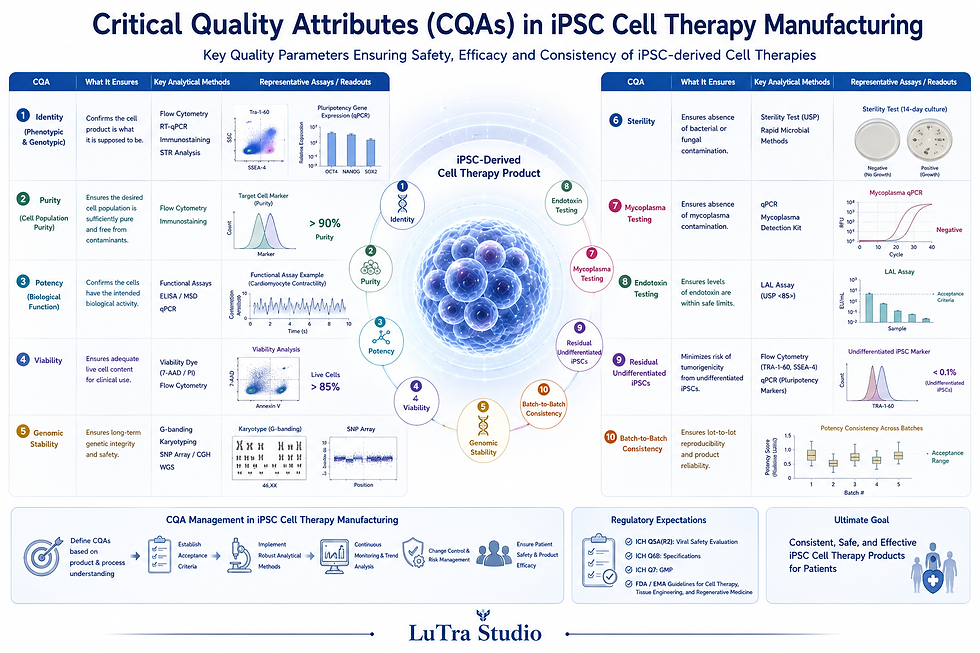
Typical release criteria include:
Identity
Purity
Viability
Sterility
Mycoplasma
Endotoxin
Genomic stability
Karyotype
Potency
A well-characterized Master Cell Bank enables consistent manufacturing over many years while minimizing lot-to-lot variability.
Cryopreservation Is Part of the Manufacturing Process
Cryopreservation is often viewed simply as a storage method.
In reality, it is an integral component of manufacturing.
Cells must retain both viability and biological function following thawing.
Critical considerations include:
Cooling rate
Cryoprotectant formulation
Post-thaw recovery
Cell viability
Functional potency
Importantly, high post-thaw viability alone does not guarantee clinical performance.
Cells that survive cryopreservation may still exhibit impaired differentiation capacity or reduced therapeutic function.
Consequently, many GMP manufacturing programs now include post-thaw potency assays as part of product release testing.
Automation Is Redefining Cell Therapy Manufacturing
As cell therapy manufacturing scales toward commercialization, manual processes are becoming increasingly difficult to sustain.
Operator-dependent variability remains one of the greatest sources of manufacturing inconsistency.
Automation addresses this challenge by improving process standardization while reducing manual intervention.
Examples of commercially available or emerging manufacturing platforms include:
CliniMACS Prodigy
Lonza Cocoon
Ori Biotech
Cellares Cell Shuttle
Cellino
These systems aim to automate key manufacturing steps such as:
Cell culture
Media exchange
Cell harvesting
Process monitoring
Quality documentation
The ultimate objective is not to replace scientists.
It is to reduce variability, improve reproducibility, and facilitate large-scale GMP manufacturing.
Artificial Intelligence and Digital Manufacturing
Automation alone is no longer sufficient.
The next generation of manufacturing is increasingly driven by artificial intelligence.
AI is already being applied to:
Colony identification
Cell counting
Morphological classification
Differentiation monitoring
Process optimization
Deviation detection
Predictive maintenance
Future manufacturing facilities may extend these capabilities even further.
Rather than simply monitoring production, AI systems could actively control manufacturing processes by dynamically adjusting:
Feeding schedules
Dissolved oxygen
Cell density
Aggregate size
Harvest timing
This evolution toward digital manufacturing represents one of the most significant technological shifts currently underway in regenerative medicine.

My Perspective
Throughout my career—from studying stem cell biology and tissue engineering at Cornell University, to working on RNA therapeutics and nanomedicine at MIT and Boston Children’s Hospital, and later leading process development, manufacturing scale-up, and automation programs in industry—I have gradually come to appreciate one important lesson.
Developing a proof of concept is only the beginning.
The real challenge is building a process that can reliably produce the same therapeutic product hundreds—or eventually thousands—of times.
Whether manufacturing lipid nanoparticles, mRNA therapeutics, or iPSC-derived cell therapies, the questions ultimately become remarkably similar:
Can the process be scaled?
Can product quality remain consistent?
Can deviations be detected before failures occur?
Can automation reduce operator variability?
Can manufacturing satisfy global regulatory expectations?
These are engineering questions just as much as biological ones.
In my view, the future leaders of regenerative medicine will not simply develop better cells.
They will build better manufacturing platforms.
The Future of iPSC Cell Therapy: Beyond Stem Cells
Over the past two decades, induced pluripotent stem cells have evolved from one of the most important discoveries in developmental biology into one of the foundational technologies driving regenerative medicine.
Yet, the field is still in its early stages.
Many of today’s clinical programs remain Phase I or Phase II studies, and significant scientific and manufacturing challenges remain before iPSC-derived therapies become routine clinical practice.
Nevertheless, one trend has become increasingly clear:
The future of iPSC technology will not be defined by stem cell biology alone.
Instead, it will be driven by the convergence of multiple disciplines.
The Future Is Platform-Based, Not Product-Based
One of the most significant shifts in biotechnology over the past decade has been the transition from developing individual therapeutic products to building technology platforms.
Historically, biotechnology companies were often organized around a single therapeutic candidate.
Today, many of the most successful companies are built around enabling platforms capable of generating multiple products.
This same transformation is occurring in regenerative medicine.
Rather than developing one iPSC-derived therapy at a time, companies are increasingly building integrated platforms capable of producing multiple cell types from a common manufacturing foundation.
A single clinical-grade iPSC line may ultimately generate:
Cardiomyocytes
Dopaminergic neurons
Retinal pigment epithelial cells
Pancreatic β cells
Natural killer (NK) cells
T cells
Macrophages
The value of the platform therefore extends far beyond any individual product.
Gene Editing Will Continue to Expand the Potential of iPSCs
Gene editing has already transformed the development of iPSC-based therapeutics.
Initially, genome editing was primarily used to correct disease-causing mutations or generate isogenic disease models.
Today, its role has expanded considerably.
Emerging applications include:
Universal donor engineering
Immune evasion strategies
Safety switches (suicide genes)
Synthetic biology circuits
Precision control of differentiation pathways
Enhanced resistance to inflammatory environments
Rather than serving only as a research tool, gene editing is becoming an integral component of therapeutic manufacturing.
Future iPSC platforms will likely combine cellular reprogramming and genome engineering into a single manufacturing workflow.
Artificial Intelligence Will Reshape Cell Manufacturing
Artificial intelligence is expected to influence nearly every stage of future iPSC manufacturing.
Current applications already include:
Automated colony selection
Cell morphology classification
Differentiation monitoring
Predictive quality control
Process optimization
However, these applications represent only the beginning.
Future manufacturing facilities may integrate AI throughout the entire production process, enabling:
Real-time process control
Predictive maintenance
Adaptive feeding strategies
Automated deviation detection
Closed-loop manufacturing
By continuously analyzing manufacturing data, AI could optimize production conditions while reducing operator-dependent variability.
This transition toward intelligent manufacturing represents one of the most exciting developments in regenerative medicine.
Digital Manufacturing Will Become the New Standard
The future manufacturing facility will likely look very different from today’s cell culture laboratories.
Rather than relying on manual observation and paper-based documentation, manufacturing will increasingly integrate:
Closed-system bioprocessing
Automated robotics
Computer vision
Process Analytical Technology (PAT)
Digital Twins
Machine learning
Electronic batch records
Real-time release analytics
Together, these technologies will create manufacturing environments that are more reproducible, data-driven, and scalable.
For cell therapies, digital manufacturing may become just as transformative as automation has been for biologics manufacturing over the past two decades.
Manufacturing Will Become the Primary Competitive Advantage
As iPSC biology continues to mature, scientific differentiation alone is unlikely to determine which companies succeed commercially.
Instead, competitive advantage will increasingly depend on manufacturing capabilities.
Future leaders will be those capable of consistently producing therapeutic cells that are:
Safe
Potent
Genetically stable
Cost-effective
Scalable
Regulatory compliant
This shift mirrors what has already occurred in monoclonal antibodies and mRNA therapeutics, where manufacturing excellence has become a key determinant of commercial success.
The same transition is now beginning in regenerative medicine.
My Perspective
Looking back on my own career—from stem cell biology and tissue engineering at Cornell University, to RNA therapeutics and nanomedicine at MIT and Boston Children’s Hospital, and later to process development, manufacturing, and automation in industry—I have come to appreciate one consistent pattern.
The technologies that ultimately transform medicine are rarely isolated breakthroughs.
Instead, meaningful progress occurs when multiple disciplines begin to converge.
iPSC technology is an excellent example.
Today, it is no longer simply a stem cell technology.
It has become a platform connecting:
Developmental biology
Gene editing
Tissue engineering
Drug discovery
Regenerative medicine
Manufacturing science
Automation
Artificial intelligence
Regulatory science
For students entering biotechnology today, learning iPSC is therefore about far more than understanding pluripotency.
It is about understanding how modern therapeutics are developed—from fundamental biology to industrial manufacturing and ultimately to patient care.
Final Thoughts
When Shinya Yamanaka first introduced induced pluripotent stem cells in 2006, few could have predicted how profoundly this discovery would influence modern biotechnology.
Less than two decades later, iPSCs have become far more than a scientific curiosity.
They now serve as the foundation for disease modeling, drug discovery, regenerative medicine, immune cell engineering, and next-generation cell therapies.
Yet perhaps the most important transformation is still underway.
The future of regenerative medicine will not be determined solely by our ability to generate better cells.
It will depend on our ability to manufacture those cells consistently, engineer them intelligently, and deliver them safely to patients at scale.
In other words, the future of iPSC technology is no longer defined only by stem cell biology.
It is defined by the integration of biology, engineering, manufacturing, automation, artificial intelligence, and regulatory science.
That convergence will determine how rapidly today’s laboratory discoveries become tomorrow’s medicines.
LuTra Studio Insight
At LuTra Studio, our goal is not simply to explain emerging technologies—it is to connect fundamental science with real-world translation.
Throughout this series, we have explored how iPSCs evolved from a landmark discovery in stem cell biology into a platform supporting regenerative medicine, advanced manufacturing, and next-generation therapeutics.
In the upcoming articles of this iPSC Master Series, we will continue exploring topics including:
GMP manufacturing strategies for iPSC-derived cell therapies
Cell banking and CMC considerations
Universal donor engineering through CRISPR
AI-driven manufacturing and digital bioprocessing
The global iPSC industry landscape
Commercialization challenges for regenerative medicine
As regenerative medicine continues to mature, understanding the intersection of biology, engineering, manufacturing, and regulatory science will become increasingly important—not only for researchers, but also for students, entrepreneurs, and biotechnology professionals working to translate scientific innovation into real-world therapies.

References
Takahashi, K., & Yamanaka, S. (2006). Induction of pluripotent stem cells from mouse embryonic and adult fibroblast cultures by defined factors. Cell, 126(4), 663–676. https://doi.org/10.1016/j.cell.2006.07.024
Takahashi, K., Tanabe, K., Ohnuki, M., et al. (2007). Induction of pluripotent stem cells from adult human fibroblasts by defined factors. Cell, 131(5), 861–872. https://doi.org/10.1016/j.cell.2007.11.019
Yu, J., Vodyanik, M. A., Smuga-Otto, K., et al. (2007). Induced pluripotent stem cell lines derived from human somatic cells. Science, 318(5858), 1917–1920.
Thomson, J. A., Itskovitz-Eldor, J., Shapiro, S. S., et al. (1998). Embryonic stem cell lines derived from human blastocysts. Science, 282(5391), 1145–1147.
Yamanaka, S. (2012). Induced pluripotent stem cells: Past, present, and future. Cell Stem Cell, 10, 678–684.
Buganim, Y., Faddah, D. A., & Jaenisch, R. (2013). Mechanisms and models of somatic cell reprogramming.Nature Reviews Genetics, 14, 427–439.
Polo, J. M., et al. (2012). A molecular roadmap of reprogramming. Cell, 151, 1617–1632.
Lipsitz, Y. Y., et al. (2016). Quality cell therapy manufacturing by design. Nature Biotechnology.
Kirouac, D. C., et al. (2023). Manufacturing challenges for pluripotent stem cell-derived therapies. Trends in Biotechnology.
Kempf, H., et al. (2015). Suspension culture of human pluripotent stem cells. Stem Cell Reports.
Serra, M., et al. (2012). Microcarrier-based expansion of human pluripotent stem cells. Stem Cell Research.
Zweigerdt, R. (2009). Large-scale production of stem cells. Cell Stem Cell.
FDA. (2024). Considerations for the Development of Human Cell Therapy Products.
FDA. Chemistry, Manufacturing, and Control (CMC) Information for Human Gene Therapy IND Applications.
EMA. (2022). Guideline on Human Cell-Based Medicinal Products.
PMDA. Guidelines for Regenerative Medicine Products.
ICH Q8(R2). Pharmaceutical Development.
ICH Q9. Quality Risk Management.
ICH Q10. Pharmaceutical Quality System.
Bravery, C. A., et al. (2013). Potency assay development for cell therapies. Cytotherapy.
ISCT. (2024). Cell Therapy Manufacturing Best Practices.
Cell & Gene Therapy Catapult. Manufacturing Cell and Gene Therapies.
Okita, K., et al. (2011). A more efficient method to generate integration-free human iPS cells. Nature Methods.
CiRA Foundation. iPSC Stock Project. https://www.cira-foundation.or.jp
Turner, M., et al. (2024). Clinical manufacturing of HLA-homozygous iPSC banks. Stem Cell Reviews and Reports.
Nakatsuji, N., et al. HLA-homozygous donor strategy for regenerative medicine.
Deuse, T., et al. (2019). Hypoimmunogenic pluripotent stem cells induce universal tolerance. Nature Biotechnology.
Han, X., et al. Generation of hypoimmunogenic human pluripotent stem cells using CRISPR engineering.
Xu, H., et al. CRISPR-mediated immune evasion of pluripotent stem cells.
Schweitzer, J. S., et al. (2020). Clinical trial of stem cell therapy for Parkinson disease. New England Journal of Medicine.
CiRA. Clinical Trial of iPSC-derived Dopaminergic Progenitor Cells.
BlueRock Therapeutics. Bemdaneprocel Clinical Program.
Aspen Neuroscience. ANPD001 Clinical Program.
Heartseed Inc. HS-005 Clinical Trial.
Cuorips Inc. Cardiomyocyte Sheet Therapy.
Menasché, P., et al. Cardiac regeneration using pluripotent stem cells.
Mandai, M., et al. (2017). Autologous induced stem-cell-derived retinal cells for macular degeneration. New England Journal of Medicine.
Takahashi, M. iPSC-derived retinal pigment epithelium transplantation.
Fate Therapeutics. iPSC-derived NK Cell Platform.
Century Therapeutics. Universal Cell Therapy Platform.
Nkarta Therapeutics. Off-the-shelf NK Cell Programs.
Lee, J., et al. Artificial Intelligence in Cell Therapy Manufacturing. Nature Reviews Bioengineering.
Nature Reviews Bioengineering. Digital Manufacturing for Cell Therapy.
Process Analytical Technology (PAT). FDA Guidance.
ISPE. Digital Biomanufacturing White Paper.
Shi, Y., Inoue, H., Wu, J. C., & Yamanaka, S. (2017). Induced pluripotent stem cell technology: A decade of progress. Nature Reviews Drug Discovery, 16, 115–130.
Rowe, R. G., & Daley, G. Q. (2019). Induced pluripotent stem cells in disease modelling and drug discovery.Nature Reviews Genetics.
De Los Angeles, A., et al. Hallmarks of pluripotency. Nature.
Trounson, A., & McDonald, C. (2015). Stem Cell Therapies in Clinical Trials. Cell Stem Cell.
Passier, R., et al. (2021). Pluripotent stem cell-based therapy for heart disease. Nature Reviews Cardiology.


Comments