

Biologics CMC Series (4): Biologics Control Strategy—Integrating Process, Analytics, and Regulatory Requirements


Executive Summary
A Biologics Control Strategy is not simply a list of tests. It is an integrated system connecting raw materials, manufacturing processes, analytical methods, specifications, and continued monitoring.
The strategy should be grounded in product and process understanding and quality risk management.
Release specifications provide a final quality check, but they cannot replace controls for upstream and downstream processing, viral safety, aseptic operations, or the supply chain.
Teams must establish scientifically meaningful relationships among Critical Quality Attributes (CQAs), Critical Process Parameters (CPPs), and Critical Material Attributes (CMAs).
A mature control strategy is not a document assembled shortly before an IND or BLA submission. It evolves throughout development, scale-up, technology transfer, commercialization, and lifecycle management.
Introduction: Quality Cannot Be Tested into a Product at the End
In biologics development, it is easy to equate product quality with release testing.
If purity, potency, aggregates, charge variants, host cell protein (HCP), and endotoxin all meet specification, the batch appears acceptable.
But the release result is only the endpoint of an entire manufacturing chain.
Is the cell bank stable and properly characterized? Are raw materials subject to lot-to-lot variability? Are pH, dissolved oxygen, temperature shifts, and harvest timing adequately controlled in the bioreactor? As purification resin is reused, does impurity clearance remain reliable? Could hold times, mixing, filtration, shipping, or the cold chain alter the product?
None of these questions can be answered by the final Certificate of Analysis alone.
That is the central idea behind a Biologics Control Strategy. The goal is not to wait until manufacturing is complete and then decide whether the product is acceptable. The goal is to build multiple, connected layers of control throughout development and manufacturing so that the process can consistently deliver a product with the intended quality.
What Is a Biologics Control Strategy?
ICH Q10 describes a control strategy as a planned set of controls derived from current product and process understanding that assures process performance and product quality.
These controls may include:
Attributes of the drug substance, excipients, and other materials
Facility and equipment operating conditions
In-process controls
Finished-product specifications
Associated analytical methods
The frequency of monitoring and control
In other words, a control strategy is not owned by one function.
It spans process development, analytical development, manufacturing, quality, regulatory affairs, supply chain, and, in some cases, clinical and device or container-closure teams.
For biologics, the strategy must also account for molecular heterogeneity, cell-culture variability, biological activity, process-related impurities, viral safety, and the sensitivity of proteins to temperature, shear, interfaces, and time.
A Control Strategy Is Not the Same as Specifications or Process Validation
These three concepts are closely related, but they are not interchangeable.
Specifications ask: Does this batch meet the predefined quality standards?
Specifications typically include tests, analytical procedures, and acceptance criteria. They are an important part of the control strategy, but they are not the entire strategy.
Even when a batch passes release specifications, not every process risk has necessarily been controlled. Some changes may remain within specification while creating a systematic drift. Other long-term risks may only become visible through stability studies, continued process verification, or trend analysis.
Process Validation asks: Can the process consistently and reproducibly manufacture an acceptable product?
Validation provides essential evidence that the control strategy works, but the control strategy is broader. It also includes raw-material controls, analytical controls, sampling strategies, facility and equipment controls, storage, shipping, and continued monitoring after approval.
A Control Strategy asks: How do we systematically manage every relevant source of product-quality risk?
It connects what the product is expected to be, which process and material factors could change it, and where and how those factors should be monitored and controlled.

From QTPP and CQA to CMA and CPP: The Scientific Framework
An executable and reviewable control strategy usually does not begin with a list of instruments. It begins with the clinical needs that the product is intended to meet and works backward from there.
Step 1: Define the Quality Target Product Profile
The Quality Target Product Profile (QTPP) describes the quality characteristics a product should possess to deliver its intended safety and efficacy.
For a monoclonal antibody, the QTPP may include dosage form, route of administration, strength, stability, sterility, container closure, and functional requirements related to the mechanism of action.
Step 2: Identify Critical Quality Attributes
A CQA is a physical, chemical, biological, or microbiological property that must remain within an appropriate limit, range, or distribution to ensure product quality.
Common biologics CQAs include:
Identity
Purity and impurities
Aggregates and fragments
Charge variants
Glycosylation profile
Higher-order structure
Biological potency
Protein concentration
Particulates
Sterility, endotoxin, and bioburden
Not every measurable attribute automatically becomes a CQA. The team should assess risk using the mechanism of action, nonclinical and clinical knowledge, platform experience, scientific literature, structure–function relationships, and the remaining uncertainty.
Step 3: Identify the Material Attributes and Process Parameters That May Affect CQAs
The next step is to build an understanding of cause and effect.
For example, glycosylation of a monoclonal antibody may be influenced by the cell line, media components, trace elements, pH, temperature, dissolved oxygen, cell age, and harvest timing. Aggregation may be affected by purification conditions, hold times, mixing, temperature excursions, concentration, and formulation.
Critical Material Attributes and Critical Process Parameters should not be assigned solely through a one-time risk-ranking workshop. Their classification should be refined through platform knowledge, scale-down models, Design of Experiments (DOE), development studies, manufacturing data, and continued trend analysis.
Step 4: Select Control Points, Control Methods, and Acceptance Ranges
For every significant risk, the team should answer:
Where in the process does the risk arise?
Where is the most effective point to prevent, reduce, or detect it?
Should it be addressed through a material specification, parameter control, in-process test, PAT, release test, or multiple layers of control?
How should sampling frequency and acceptance criteria be established?
What action should be taken when a result falls outside an alert, action, or proven acceptable range?

What Layers Should a Biologics Control Strategy Include?
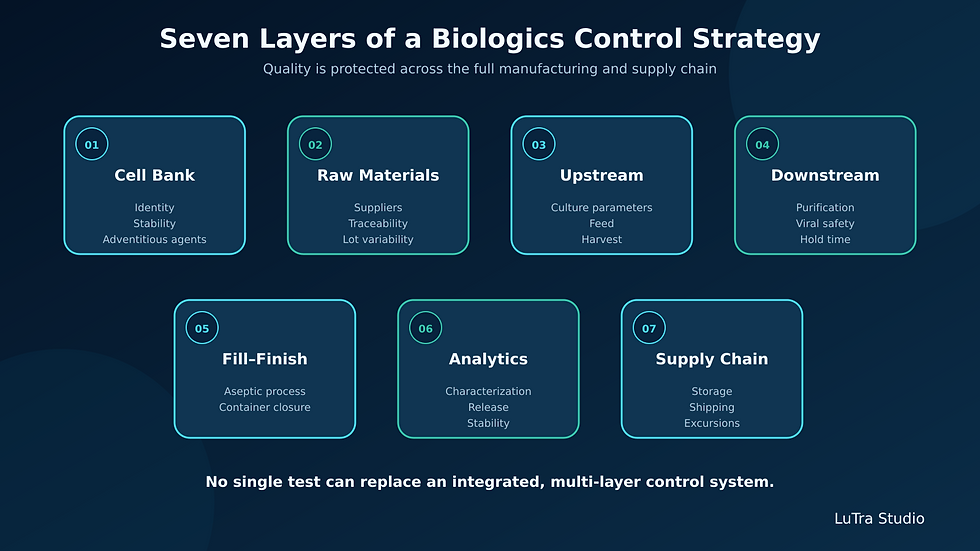
A mature strategy rarely relies on a single checkpoint. It builds several layers of protection.
1. Cell Substrate and Cell Bank Controls
These controls include cell-line history, identity, genetic stability, the Master Cell Bank, Working Cell Bank, adventitious-agent testing, storage, and traceability.
The cell substrate is the starting point of the biologics manufacturing process. When this layer is weak, downstream purification and release testing cannot reliably compensate for it.
2. Raw-Material and Supplier Controls
Media, feeds, resins, filters, single-use components, excipients, and disposable materials may all influence process performance or product quality.
Control extends beyond incoming specifications. It may include supplier qualification, change notification, material traceability, assessment of materials of animal origin, lot testing, and functional testing when necessary.
3. Upstream Process Controls
Upstream controls may cover the inoculum train, cell density, viability, pH, dissolved oxygen, agitation, gas flow, temperature, feeding strategy, metabolites, culture duration, and harvest criteria.
The objective is not to label every parameter as a CPP. It is to determine which parameters truly affect a CQA or downstream process capability.
4. Downstream Process Controls
These may include chromatography load, flow rate, pooling criteria, column performance, resin lifetime, filter loading, viral inactivation, viral filtration, buffer conditions, hold time, and bioburden control.
In addition to controlling product-related impurities, the purification process should consistently remove process-related impurities such as HCP, residual DNA, Protein A, media components, and viruses.
5. Formulation, Fill–Finish, and Container-Closure Controls
Protein concentration, excipient composition, mixing, sterile filtration, fill accuracy, container-closure integrity, particulates, light exposure, freeze–thaw cycles, and interfacial stress may all influence the final product.
For sterile products, aseptic process controls and the contamination control strategy are inseparable parts of the overall control system.
6. Analytical Control Strategy
Analytical methods should not enter the process only after manufacturing is complete. Their specificity, sensitivity, precision, range, and stability-indicating capability determine whether the team can detect meaningful differences.
Characterization, in-process, release, and stability methods serve different purposes and should not all be evaluated using the same expectations.
7. Storage, Shipping, and Supply-Chain Controls
Quality risks do not disappear when the product leaves the manufacturing facility. Temperature excursions, vibration, orientation, light exposure, freeze–thaw cycles, and handling before administration may affect a biologic.
Shipping validation, cold-chain monitoring, excursion assessment, and in-use stability should therefore be part of the control strategy.
Case Study: Building an End-to-End Control Strategy for a Monoclonal Antibody
Consider a CHO cell-derived monoclonal antibody. Early characterization indicates that potency and Fc-mediated function may be influenced by glycosylation, aggregation, and higher-order structure.
The control strategy should not simply add glycan, SEC, and potency assays to the release panel. The team needs to trace each risk upstream to its potential sources.
CQA: Glycosylation Profile
Potential sources of variability include the cell line, media lot, trace metals, culture pH, temperature shifts, dissolved oxygen, culture duration, and harvest timing.
The controls may include:
Cell-bank and raw-material qualification
Media and feed controls
Defined bioreactor operating ranges
In-process monitoring of cell growth and metabolites
Harvest criteria
Glycan characterization and appropriate release or monitoring tests
Continued process verification and trend analysis
CQA: Aggregates
Potential sources include low-pH viral inactivation, chromatography conditions, high protein concentration, mixing, hold time, temperature, and freeze–thaw cycles.
The strategy may combine:
Development studies defining acceptable hold-time and temperature ranges
Mixing and pump controls
Pooling criteria
Formulation optimization
SEC release specifications
Stability-indicating methods
Shipping and excursion controls
Process-Related Impurity: Host Cell Protein
HCP cannot be controlled solely through a final ELISA result. The team also needs to understand harvest variability, chromatography clearance, resin reuse, method coverage, and whether process drift could alter the HCP population.
Controls may therefore be distributed across upstream harvest criteria, downstream operating ranges, resin-lifecycle management, in-process monitoring, release testing, and periodic characterization.
The most important lesson from this case is that one CQA is usually protected by several controls, while one process parameter may affect several CQAs at the same time.
How Does the Control Strategy Connect to INDs, BLAs, and CTD Module 3?
A control strategy is not a single field that can be completed in the CTD. Its elements are distributed across multiple sections of Module 3.
Common connections include:
3.2.S.2: Manufacturing process and process controls
3.2.S.2.3: Control of materials
3.2.S.2.4: Controls of critical steps and intermediates
3.2.S.2.5: Process validation and/or evaluation
3.2.S.4: Control of drug substance
3.2.P.3: Manufacture of drug product
3.2.P.4: Control of excipients
3.2.P.5: Control of drug product
3.2.P.8: Stability
Reviewers are not simply checking whether data exist in each section. They are evaluating whether the overall argument is coherent.
If a submission defines an attribute as a high-risk CQA but provides no appropriate process control, analytical method, or monitoring plan, the logic is incomplete. Conversely, if too many parameters are classified as critical without supporting data, future manufacturing operations and post-approval change management may become unnecessarily rigid.
A Development-Stage Control Strategy Can Be Incomplete, but It Still Needs a Clear Logic
Data are limited in early clinical development, so the control strategy cannot be as mature as it is at the commercial stage.
However, phase-appropriate does not mean waiting until Phase 3 to begin.
Even in early development, a team should be able to explain:
Which CQAs are known or potentially important?
Where are the major product and process uncertainties?
Are the current analytical methods capable of detecting meaningful changes?
Which parameters and material attributes are being monitored?
Which knowledge gaps will be addressed later in development?
How could scale-up, site transfer, or formulation changes affect the current controls?
The control strategy matures as knowledge accumulates. Early programs may rely on broader testing and more conservative operating ranges. Later, stronger process understanding, validation, historical data, and monitoring should provide a more scientifically grounded approach.
Lifecycle Management: The Control Strategy Does Not Freeze After Approval
After commercialization, raw-material suppliers may change, equipment will be updated, analytical methods will evolve, manufacturing sites may be transferred, and capacity may be scaled up.
A central principle of ICH Q10 and ICH Q12 is that the pharmaceutical quality system, knowledge management, quality risk management, and post-approval change management should operate as a connected loop.
A mature control strategy should continue to evolve based on:
Continued process verification
Annual product quality review or product quality review
Deviation, OOS, OOT, and CAPA trends
Stability trends
Complaints and pharmacovigilance signals
Supplier and raw-material changes
Equipment, facility, and analytical-method changes
New product and process knowledge
The important question is not merely whether every result remains within specification. The team should also determine whether the process is drifting in a particular direction and whether the existing controls can detect that drift before it becomes a quality event.
This connects directly to ICH Q5E comparability, discussed in Series 3. When the process or control strategy changes, the team should use a risk-based comparability exercise to demonstrate that post-change product quality remains connected to the established safety and efficacy experience.

Common Mistakes: Why Some Control Strategies Look Complete but Remain Fragile
Mistake 1: Classifying Every Measurable Attribute as a CQA
This removes the discriminatory value of the risk assessment and fails to identify which attributes are truly connected to safety and efficacy.
Mistake 2: Labeling Every Process Parameter as a CPP
Overclassification increases operational burden and may complicate future post-approval changes. Criticality should be supported by data and mechanistic understanding.
Mistake 3: Relying Only on Release Testing
End-product testing alone is generally insufficient to detect low-frequency contamination, process drift, equipment state, supplier variability, or future stability risks.
Mistake 4: Completing the Risk Assessment Once and Never Updating It
A risk assessment should be a living document. New information from development, scale-up, validation, deviations, and commercial manufacturing may change the original risk ranking.
Mistake 5: Allowing Each CMC Function to Write Its Own Story
When process, analytical, quality, and regulatory documents use different CQA definitions, parameter classifications, or acceptance rationales, internal contradictions often become visible during submission review.
What Practical Capabilities Does a Team Need?
A team capable of building an effective control strategy needs more than the ability to complete a risk-assessment table. It should be able to:
Translate clinical needs and the mechanism of action into the QTPP and CQAs
Establish structure–function and process–product relationships
Design scale-down models and DOE studies
Distinguish CMAs, CPPs, key process parameters, and non-critical parameters
Build a phase-appropriate analytical strategy
Integrate specifications, in-process controls, PAT, and monitoring
Plan process validation and continued process verification
Map the control strategy clearly into CTD Module 3
Manage technology transfer, comparability, and post-approval changes
The core skill is not memorizing ICH guidelines. It is translating scientific understanding into an evidence chain that manufacturing can execute, the quality system can monitor, and regulatory reviewers can understand.
My Perspective: Control Strategy Is the Common Language of a CMC Team
Through my own experience coordinating process development, scale-up, analytical work, animal studies, CDMO transfer, and GLP/GMP-related activities, I have come to see the control strategy as much more than a regulatory deliverable.
It functions as a shared map.
Process scientists can see which parameters truly affect the product. Analytical scientists understand which methods require sufficient sensitivity. Manufacturing teams know which operating ranges cannot be managed by experience alone. Quality teams can establish monitoring and investigation logic. Regulatory teams can translate these decisions into a consistent submission narrative.
Many development problems emerge late not because the team lacks data, but because the data were never connected.
Mature CMC development is not about every function completing its own report. It is about every report answering the same question: Why do we believe this process can consistently manufacture a product with the intended quality?
How Can LuTra Studio Support Biologics CMC Teams?
LuTra Studio supports biologics, mRNA/LNP, and cell and gene therapy teams in developing and organizing:
Product and process risk assessments
QTPP, CQA, CMA, and CPP mapping
Phase-appropriate control strategies
Analytical and specification strategies
Process development, scale-up, and technology-transfer planning
Comparability and lifecycle-management strategies
CTD Module 3 content architecture and gap assessments
FDA, ICH, and EU CMC regulatory intelligence
Our role is not to replace scientific judgment with a template. It is to connect information distributed across process, analytical, quality, and regulatory functions and turn it into a coherent, executable, and review-ready CMC strategy.
If your team is preparing an IND, BLA, process scale-up, CDMO transfer, or control-strategy gap assessment, you are welcome to contact me through LuTra Studio.
Conclusion: Quality Is Designed Throughout the Process, Not Tested in at the End
A control strategy is often reduced to a large table: CQAs on the left, CPPs in the center, and testing methods on the right.
But an effective strategy must be supported by product knowledge, process understanding, risk management, analytical capability, and lifecycle monitoring.
Specifications tell us whether a batch meets predefined standards. Process validation demonstrates whether the process can operate consistently. Comparability manages the connection between products before and after a change. The control strategy integrates all of these elements into one coherent quality framework.
That integration is what allows Biologics CMC to move from simply making a product to manufacturing it consistently, supporting a successful submission, and sustaining long-term commercialization.


Comments