

Biologics CMC Series (1) Biologics CMC Regulatory Framework: A Practical Guide to ICH, FDA, EMA, and CTD Module 3


Biologics CMC Regulatory Framework: Executive Summary
If you only have three minutes, remember these five points:
Biologics CMC is not a single regulation. It is a lifecycle framework connecting the product, manufacturing process, analytical methods, control strategy, and pharmaceutical quality system.
ICH provides a shared scientific language. FDA and European authorities apply those principles through their own laws, submission pathways, and post-approval change procedures.
CTD Module 3 is the filing structure; ICH Q5–Q12 provides much of the scientific logic behind the information placed within it.
For biologics, a manufacturing change can alter the product. Characterization, comparability, process control, and lifecycle planning therefore need to develop together.
The most effective way to learn Biologics CMC is to build a map first, then use individual guidelines to answer product- and stage-specific questions.
This is the first article in the LuTra Studio Biologics CMC series. Later articles will examine specifications, comparability, stability, viral safety, cell substrates, quality risk management, pharmaceutical quality systems, and post-approval change management.
Introduction: Why Biologics CMC Is More Than a Long List of Regulations
When people first encounter Chemistry, Manufacturing, and Controls, one question usually comes first:
“Which guideline should I read?”
It is a reasonable question, but it can also send a new CMC professional in the wrong direction.
Biologics CMC is not defined by one document. A development team may need to work with ICH Q5A, Q5C, Q5D, Q5E, Q6B, Q8, Q9, Q10, Q11, and Q12, alongside FDA regulations and guidance, EMA scientific guidelines, European GMP requirements, and regional variation procedures.
Each document has a purpose. The difficulty is understanding how they connect.
In my work across mRNA, lipid nanoparticles, antibody-based therapeutics, and IND-enabling programs in biotechnology startups, the most persistent challenges were rarely caused by one person not knowing a particular regulation. More often, different functions were speaking different technical languages:
Process Development focused on process parameters, scale-up, and manufacturing capability.
Analytical Development focused on assay performance, critical quality attributes, and specifications.
Quality focused on GMP, deviations, change control, CAPA, and the quality system.
Regulatory Affairs focused on dossier structure, commitments, submission strategy, and regional requirements.
Clinical and executive teams needed to know whether a difference could affect safety, efficacy, supply, timeline, or business risk.
The Biologics CMC regulatory framework connects these questions into one traceable quality argument.
What Is Biologics CMC?
CMC stands for Chemistry, Manufacturing, and Controls. For biologics, however, that expansion can make the discipline sound narrower than it is.
Biologics CMC asks a larger question:
Do we understand the product well enough to manufacture it consistently, control it with suitable methods, and demonstrate throughout its lifecycle that each batch has the intended quality?
Biologics may include monoclonal antibodies, recombinant proteins, vaccines, certain nucleic acid therapeutics, cell and gene therapy products, and other complex products produced using biological systems.
The applicable pathway is modality-specific. This article presents a common framework, not a universal checklist. Vaccines, blood products, biosimilars, antibody-drug conjugates, combination products, and cell and gene therapies generally require additional product-specific guidance.
Why Is the Biologics CMC Regulatory Framework So Complex?
Biologics are rarely one perfectly uniform molecular species
A small-molecule drug can often be described using a discrete chemical structure. A therapeutic protein may contain glycosylation patterns, charge variants, size variants, oxidation, deamidation, and aggregates.
Heterogeneity does not automatically mean poor quality. The development team must determine:
Which variants are expected features of the product?
Which attributes could affect safety or efficacy?
Which components are product-related or process-related impurities?
Can the analytical methods distinguish and quantify meaningful differences?
How should acceptance criteria relate to clinical experience, process capability, stability, and method variability?
The manufacturing process can shape the product
The familiar phrase “the process is the product” is an oversimplification, but it captures an important idea. Cell line, raw materials, culture conditions, purification, hold times, equipment, manufacturing scale, and site can influence a biologic’s quality attributes.
A process change therefore raises more than an operational question. The company needs to determine whether the pre-change and post-change products remain comparable in quality and whether residual uncertainty could affect safety or efficacy. This is the core of ICH Q5E comparability.
Product knowledge accumulates over the lifecycle
A Phase 1 program cannot have the same manufacturing history as a commercial product. At the same time, an early development stage does not justify every data gap.
A sound CMC strategy matures with the program:
Establish controls sufficient to support early clinical safety and reliable supply.
Expand process understanding, analytical capability, and stability knowledge as development progresses.
Define a mature commercial control strategy and complete process validation for registration.
Manage the approved product through continued process verification, change control, comparability, and regional regulatory reporting.
The Four Layers of the Biologics CMC Regulatory Framework
Rather than treating ICH, FDA, and EMA as three isolated categories, it is more useful to organize Biologics CMC into four layers.
Layer | Core question | Common sources or systems |
Law and enforceable requirements | What must the company do? | PHS Act, FD&C Act, 21 CFR, EU legislation, GMP requirements |
Scientific and quality guidance | What scientific evidence supports product quality? | ICH Q5–Q12, FDA guidance, EMA scientific guidelines |
Submission structure | Where should the evidence appear? | CTD/eCTD, especially Modules 2.3 and 3 |
Company execution system | How does the company perform and sustain the work? | PQS, SOPs, change control, deviations/CAPA, knowledge management, supplier oversight |
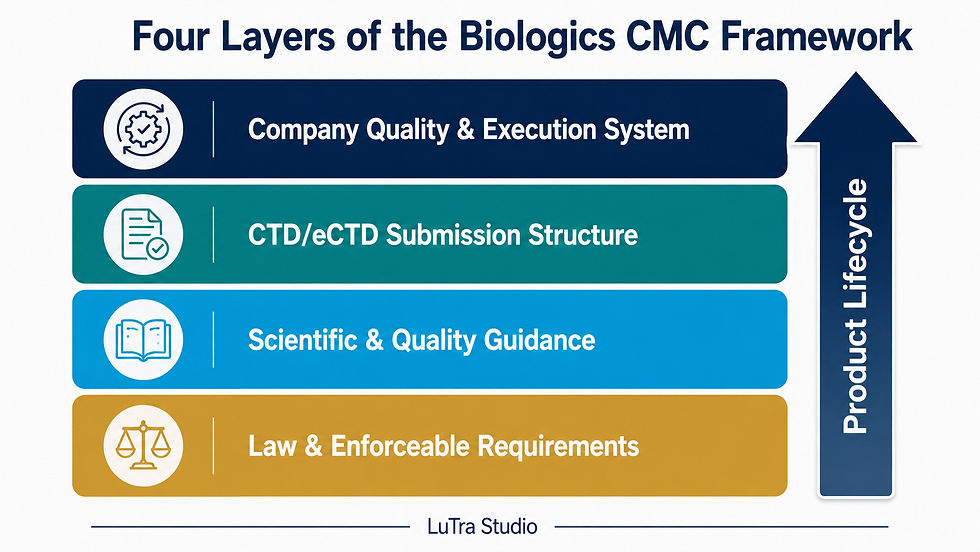
These layers are related, but they are not interchangeable. ICH Q9 provides principles for quality risk management; it is not a complete GMP regulation. CTD Module 3 organizes information; it does not determine whether an assay is scientifically suitable. An internal SOP governs company execution; it does not replace regulatory reporting requirements.
Layer 1: ICH Quality Guidelines as a Shared Scientific Language
The International Council for Harmonisation does not replace national or regional law. Its guidelines help regulators and industry use a more consistent scientific language when evaluating quality, safety, and efficacy.
For Biologics CMC, the most relevant quality guidelines can be grouped into three areas.
Product and biological process foundations: ICH Q5 and Q6B
Guideline | Main question | What practitioners should understand |
ICH Q5A(R2) | How should viral safety be evaluated for biotechnology products derived from human or animal cell lines? | Risk assessment, cell bank testing, viral clearance, and inactivation studies |
ICH Q5B | How should the expression construct be analyzed? | Construct identity, sequence, and genetic stability |
ICH Q5C | How should stability be established for biologics? | Stability-indicating profile, storage conditions, and shelf life |
ICH Q5D | How should cell substrates be established and characterized? | MCB/WCB history, origin, testing, and management |
ICH Q5E | How is comparability shown after a manufacturing change? | Risk assessment, analytical comparison, and when nonclinical or clinical bridging may be needed |
ICH Q6B | How are specifications established for biologics? | Identity, purity, impurities, potency, quantity, and acceptance criteria |
Together, these guidelines ask: What is the product, where did it come from, what risks are inherent to its production, and how will those risks be measured and controlled?
Development, risk, and quality systems: ICH Q8–Q11
ICH Q8(R2), Pharmaceutical Development, connects formulation and process development with quality target product profiles, design space, and control strategy.
ICH Q9(R1), Quality Risk Management, defines principles for risk assessment, control, communication, and review. The revision also emphasizes subjectivity, appropriate formality, and product-availability risks.
ICH Q10, Pharmaceutical Quality System, connects management responsibility, CAPA, change management, process performance, and product quality monitoring across the lifecycle.
ICH Q11, Development and Manufacture of Drug Substances, focuses on drug-substance process development, source materials, process understanding, and control strategy.
These guidelines answer a different question: How do we transform product knowledge and risk assessment into a manufacturing and quality system that can be maintained and improved?
Post-approval lifecycle management: ICH Q12
ICH Q12 focuses on managing changes to approved products. Important tools include:
Established Conditions (ECs)
Post-Approval Change Management Protocols (PACMPs)
Product Lifecycle Management (PLCM) documents
Connections between the pharmaceutical quality system and change management
Q12 does not mean every change becomes non-reportable. It helps companies and regulators clarify which conditions carry regulatory commitments and how supporting data and reporting categories can be planned.
Implementation remains dependent on regional legal frameworks. A Q12 strategy does not make U.S. and EU procedures identical.

Layer 2: The U.S. FDA Biologics CMC Framework
In the United States, the legal framework for biological products is grounded primarily in section 351 of the Public Health Service Act. Many biologics reach the market through a Biologics License Application.
Frequently relevant regulations include:
21 CFR Parts 210 and 211: general current good manufacturing practice requirements for drugs.
21 CFR Parts 600–680: requirements for biological products; applicability varies by product type.
21 CFR Part 601: licensing, BLAs, and post-approval requirements.
21 CFR 601.12: the reporting framework for changes to an approved BLA.
FDA post-approval reporting categories
Under 21 CFR 601.12, manufacturing changes are classified according to their potential to adversely affect product identity, strength, quality, purity, or potency as these may relate to safety or effectiveness.
Prior Approval Supplement (PAS): a major change that generally requires FDA approval before distribution of product made using the change.
Changes Being Effected in 30 Days (CBE-30): a moderate change for which distribution generally begins at least 30 days after FDA receives the supplement, unless FDA determines otherwise.
CBE-0: certain changes that may be implemented upon FDA receipt of the supplement.
Annual Report (AR): generally used for changes with minimal potential for an adverse effect on product quality.
The category cannot be assigned from the name of the change alone. Two “equipment changes” or “site transfers” can carry different risks depending on product contact, operating principle, process step, validation, comparability evidence, and product characteristics.
The better regulatory question is:
Through what mechanisms could this change affect product quality, what evidence reduces the uncertainty, and how do current regulations and product-specific guidance classify the scenario?
Layer 3: EMA and the EU Biologics CMC Framework
EMA scientific guidelines support the quality, safety, and efficacy portions of medicinal-product applications. Once adopted in the EU, ICH guidelines are also important scientific references.
For many biotechnology-derived medicinal products, the centralized authorization procedure is closely linked to Regulation (EC) No 726/2004. The exact route still depends on the product classification and legal basis.
Quality packages may need to consider:
ICH quality guidelines
EMA biological and quality guidelines
Applicable European Pharmacopoeia chapters and monographs
EudraLex Volume 4 EU GMP guidelines
Product-specific guidance for monoclonal antibodies, vaccines, biosimilars, plasma-derived products, or advanced therapy medicinal products
The revised EU variations framework applies in 2026
The Variation Regulation was amended and has applied since January 1, 2025. The revised European Commission Variations Guidelines apply from January 15, 2026.
This matters to CMC teams because changes involving manufacturing sites, processes, specifications, analytical procedures, packaging, and supply arrangements must be assessed under the current classification and procedural framework.
It is no longer sufficient for training material to state only that EU variations are divided into Type IA, IB, and II. Teams must confirm the current classification conditions, documentation requirements, implementation timing, and procedural guidance.
Layer 4: CTD Module 3 as the Common Filing Structure
Regulations and scientific guidance shape the evidence. The Common Technical Document organizes it.
The sections most important to CMC teams are:
Module 2.3: Quality Overall Summary
Module 3: Quality
A simplified Module 3 structure is shown below.
CTD location | Content |
3.2.S | Drug Substance: manufacture, characterization, control, reference standards, container closure, and stability |
3.2.P | Drug Product: composition, pharmaceutical development, manufacture, excipients, control, container closure, and stability |
3.2.A | Appendices, including facilities/equipment and adventitious-agent safety evaluation |
3.2.R | Regional information required by individual authorities |
Knowing the headings does not mean a team knows how to write a strong dossier. Reviewers also assess whether:
Process descriptions agree with batch records, validation, and the control strategy.
Critical quality attributes and critical process parameters have a scientific rationale.
Analytical procedures are fit for purpose and their qualification or validation matches the development stage.
Specifications are supported by clinical experience, manufacturing history, stability, and method capability.
Sections tell a consistent story without unexplained contradictions.
The dossier is not a stack of independent reports. It is one integrated and traceable quality argument.
A Monoclonal Antibody Example Across the Biologics CMC Framework

Cell line and raw materials
Establish and describe master and working cell banks using ICH Q5D principles.
Evaluate the expression construct and genetic stability under ICH Q5B.
Plan adventitious-agent and viral-safety controls using ICH Q5A(R2) and product-specific risk.
Place source, testing, and control information in 3.2.S.2 and applicable appendices.
Drug-substance process and characterization
Use Q8, Q9, and Q11 to build process understanding and the control strategy.
Assess how upstream and downstream parameters affect glycosylation, aggregation, charge variants, host-cell proteins, and residual DNA.
Describe manufacture and controls in 3.2.S.2, and structure, characterization, and impurities in 3.2.S.3.
Specifications and analytical control
Use Q6B principles to define identity, purity and impurities, potency, quantity, and other relevant tests.
Present drug-substance specifications in 3.2.S.4 and drug-product specifications in 3.2.P.5.
Justify acceptance criteria using development and clinical batches, process capability, stability, analytical variability, and knowledge of safety and efficacy.
Stability and shelf life
Use Q5C and applicable Q1 principles to design long-term, accelerated, stress or forced-degradation, and in-use studies.
Select methods because they detect quality-relevant changes, not simply because they are available.
Present drug-substance and drug-product stability information in 3.2.S.7 and 3.2.P.8, respectively.
Process changes and post-approval management
When changing a site, scale, or purification step, build a risk-based comparability plan using Q5E.
Determine whether analytical evidence is sufficient or whether nonclinical or clinical data may be needed.
After approval, use 21 CFR 601.12 in the United States or the current EU variations framework to determine reporting category and implementation timing.
Where appropriate, use Q12 tools such as ECs, PACMPs, or PLCM documents to improve predictability.
How Different Functions Use the Biologics CMC Regulatory Framework
Function | Most important connections |
Process Development | CPP/CQA relationships, scale-up, process characterization, control strategy, comparability |
Analytical Development | Method purpose, CQA coverage, qualification/validation, specifications, stability indication |
Manufacturing/MSAT | Technology transfer, batch consistency, continued verification, deviations, and change impact |
Quality Assurance | PQS, data integrity, supplier quality, change control, CAPA, GMP compliance |
Regulatory Affairs | CTD strategy, regional requirements, commitments, authority interactions, reporting categories |
Project and Portfolio Leadership | CMC risk, critical path, clinical supply, commercial readiness, resources, and decision timing |
A cross-functional team does not need every person to memorize the same 30 guidelines. It needs every function to understand how its data affects the next quality and development decision.
Five Common Mistakes When Learning Biologics CMC
Reading regulations from beginning to end without a question
Regulations are not an exam syllabus. Define the product, stage, region, and decision first, then identify the relevant source.
Treating guidance as a universal checklist
Guidelines express principles and expectations. Product risk, modality, process, and development stage determine the evidence needed. A product-specific justification remains essential.
Waiting until submission writing to assemble the CMC story
When process, analytical, quality, and regulatory teams first reconcile data during dossier authoring, they often discover inconsistent batch definitions, mismatched method versions, unbridged process changes, or studies initiated too late.
Treating specifications as the entire characterization program
Characterization builds deep product understanding. Specifications support routine control. Not every characterization test belongs in release testing, but the two programs must support one another.
Treating comparability as a batch-to-batch spreadsheet exercise
Comparability is a risk-based argument connecting the change, plausible mechanisms of impact, assay sensitivity, batch selection, acceptance approach, residual uncertainty, and any need for additional studies.
A Practical Learning Path for Biologics CMC
Learn the product and CTD structure: understand drug substance, drug product, CQA, CPP, specifications, and Module 3.
Study Q6B: learn how characterization and analytical methods support routine specifications.
Study Q5E: understand the logic of process changes and comparability.
Add Q5A(R2), Q5D, and Q5C: cover viral safety, cell substrates, and stability.
Study Q8, Q9, Q10, and Q11: connect individual studies to development and the quality system.
Study Q12 and regional variation procedures: bring product knowledge into post-approval lifecycle management.
Add modality-specific guidance for monoclonal antibodies, vaccines, cell and gene therapies, RNA products, biosimilars, or other relevant platforms.
This is also the logic of this article series: establish orientation first, then examine each topic in depth.
Biologics CMC Regulatory Developments to Watch in 2026
ICH Q5A(R2) has replaced the earlier Q5A framework and should be read in the context of modern, risk-based viral-safety strategies.
ICH Q9(R1) is the current revision. Quality risk management should address subjectivity, appropriate formality, and risks related to product availability—not merely produce a risk-assessment form.
ICH Q6(R1) is being developed to modernize Q6A and Q6B, including clinically relevant specifications, prior knowledge, risk-based control strategies, and broader product modalities. Until the revision reaches completion and regional implementation, it should not be presented as an effective final requirement.
ICH M4Q(R2) entered Step 2 draft/public consultation in 2025, and supporting mapping and illustrative materials continued to appear in 2026. Current dossiers must still follow applicable adopted regional requirements.
The revised EU Variations Guidelines apply from January 15, 2026. Teams planning post-approval CMC changes in Europe should use the current classifications and procedures.
These developments do not affect Regulatory Affairs alone. They may change analytical strategy, comparability packages, data structure, implementation timelines, and global supply planning.
Conclusion: Build the Map Before You Memorize the Details
Biologics CMC can initially feel like a collection of unrelated acronyms: CQA, CPP, QTPP, specification, comparability, PACMP, PQS, PPQ, and CPV.
Placed within one framework, the logic becomes clearer:
Understand the product and manufacturing process.
Identify quality attributes that may affect safety and efficacy.
Develop analytical and process controls that manage meaningful risks.
Present the evidence consistently within the CTD structure.
Manage knowledge, risk, and change across the product lifecycle.
A mature CMC strategy is not measured by document volume. It is demonstrated when each data package answers a defined question and the scientific argument remains consistent across functions, development stages, and regions.
The next article in this series examines ICH Q6B and a practical question: How do product characterization, critical quality attributes, and analytical methods become scientifically justified release and shelf-life specifications?
How LuTra Studio Supports Biologics CMC and Technical Strategy
LuTra Studio combines practical experience in biologics, mRNA, lipid nanoparticles, drug delivery, analytical development, process development, and early-stage biotechnology operations to help teams translate fragmented scientific data into clear and actionable CMC strategies.
Potential areas of collaboration include:
Biologics, RNA, and LNP product-development and CMC roadmaps
CQA, analytical strategy, and control-strategy assessments
IND-enabling CMC document structure and gap analysis
Technology transfer, CRO/CDMO oversight, and cross-functional communication
Scientific content, technical presentations, and market communication
If your team is moving from research into development—or managing scale-up, analytical strategy, cross-functional alignment, or submission readiness—visit LuTra Studio to start a conversation.
References | Official Regulations and Guidelines
International Council for Harmonisation. ICH Quality Guidelines.
ICH. Q5A(R2), Viral Safety Evaluation of Biotechnology Products Derived from Cell Lines of Human or Animal Origin.
ICH. Q5B, Analysis of the Expression Construct in Cells Used for Production of r-DNA Derived Protein Products.
ICH. Q5C, Quality of Biotechnological Products: Stability Testing of Biotechnological/Biological Products.
ICH. Q5D, Derivation and Characterisation of Cell Substrates Used for Production of Biotechnological/Biological Products.
ICH. Q5E, Comparability of Biotechnological/Biological Products Subject to Changes in Their Manufacturing Process.
ICH. Q6B, Specifications: Test Procedures and Acceptance Criteria for Biotechnological/Biological Products.
ICH. Q8(R2), Pharmaceutical Development; Q9(R1), Quality Risk Management; Q10, Pharmaceutical Quality System; Q11, Development and Manufacture of Drug Substances; Q12, Pharmaceutical Product Lifecycle Management.
U.S. Food and Drug Administration. Chemistry, Manufacturing, and Controls Changes to an Approved Application: Certain Biological Products, 2021.
Electronic Code of Federal Regulations. 21 CFR § 601.12—Changes to an Approved Application.
European Medicines Agency. Biological Guidelines.
European Medicines Agency. Quality Guidelines.
European Medicines Agency. Guidance on the Application of the Revised Variations Framework, applicable from January 15, 2026.
European Commission. Regulation (EC) No 726/2004 and Commission Regulation (EC) No 1234/2008, as amended.
Regulations and guidance evolve. Product-development and submission strategies should be confirmed against the latest requirements for the product type, development stage, and target markets. This article is educational and does not constitute legal or regulatory advice.


Comments